

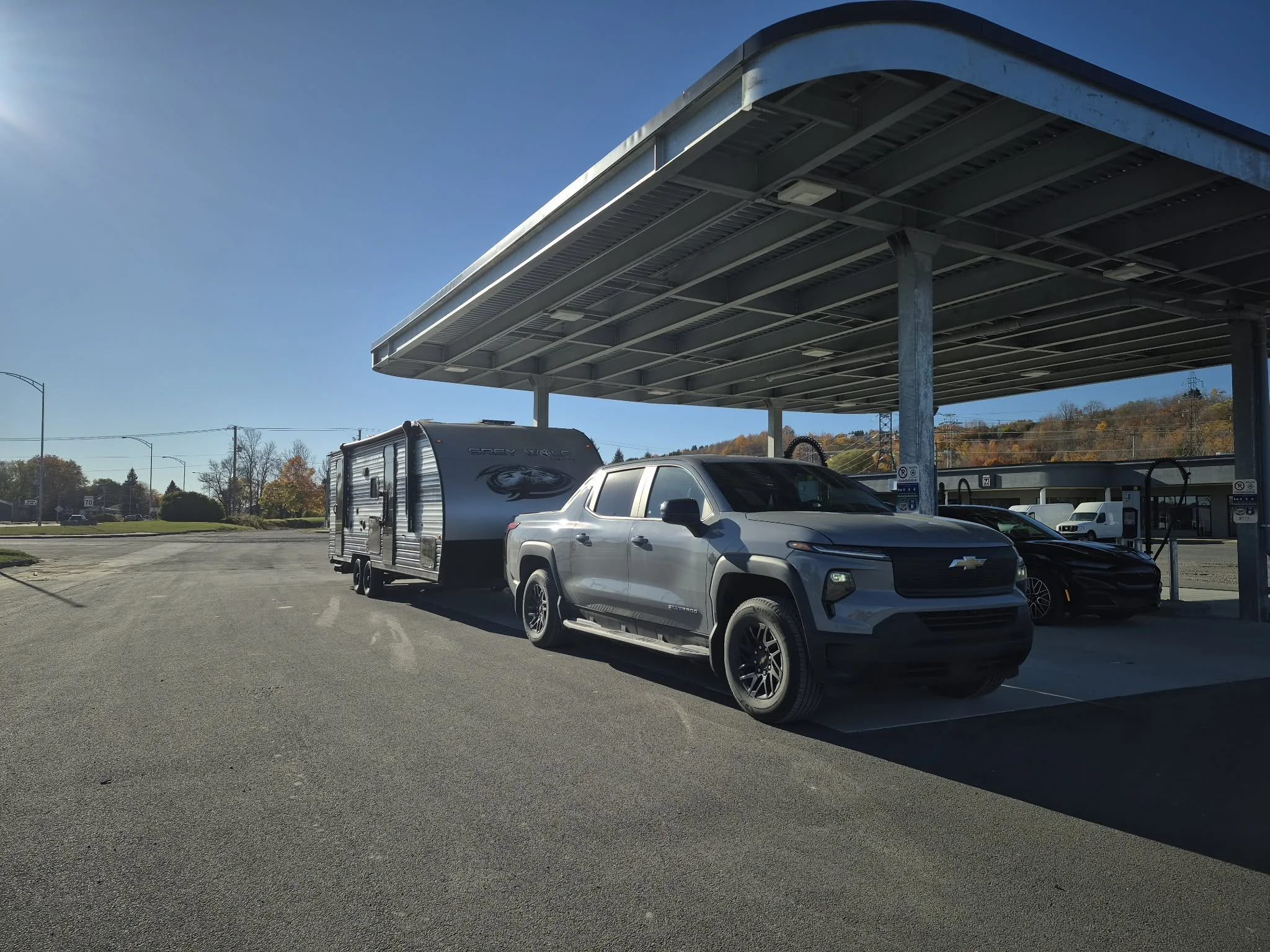
The written companion to our video, "Canada's Harshest EV Towing Test — And the Silverado EV Made It Look Easy."
Every electric-truck towing test you've ever watched was driven like the driver was apologizing to the battery. Slow lane. Feather the throttle. Coast the hills. Not this one. We hooked a 29-foot camper to my 2026 Chevrolet Silverado EV Work Truck, pointed it at the steepest highway grades in Quebec, and drove it the way I drive everything — in the fast lane, passing people uphill, at whatever speed the road allowed. No hypermiling, no compromises. Then we wrote down what it actually cost.
The Route: Why This Is the Harshest Test
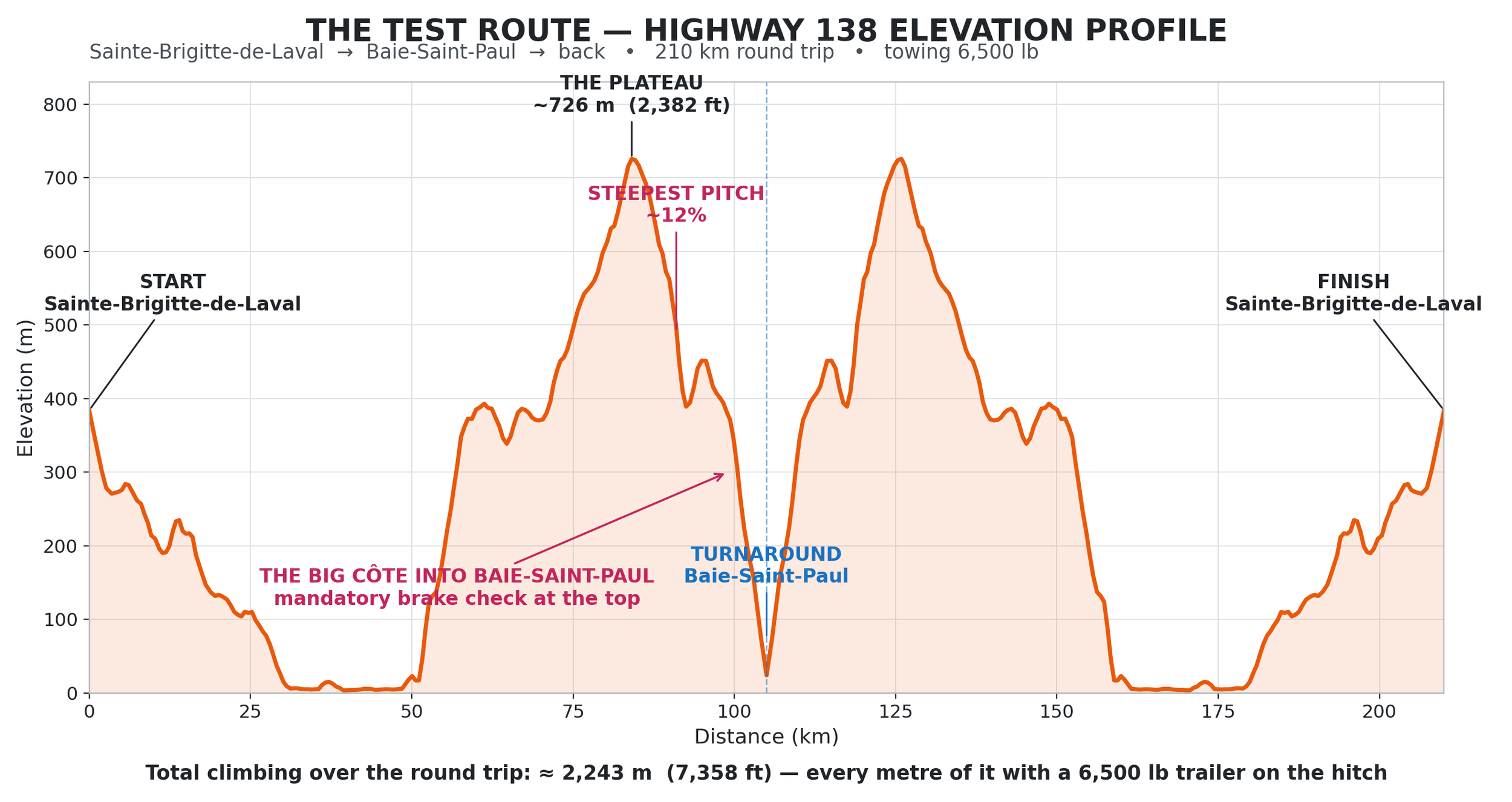
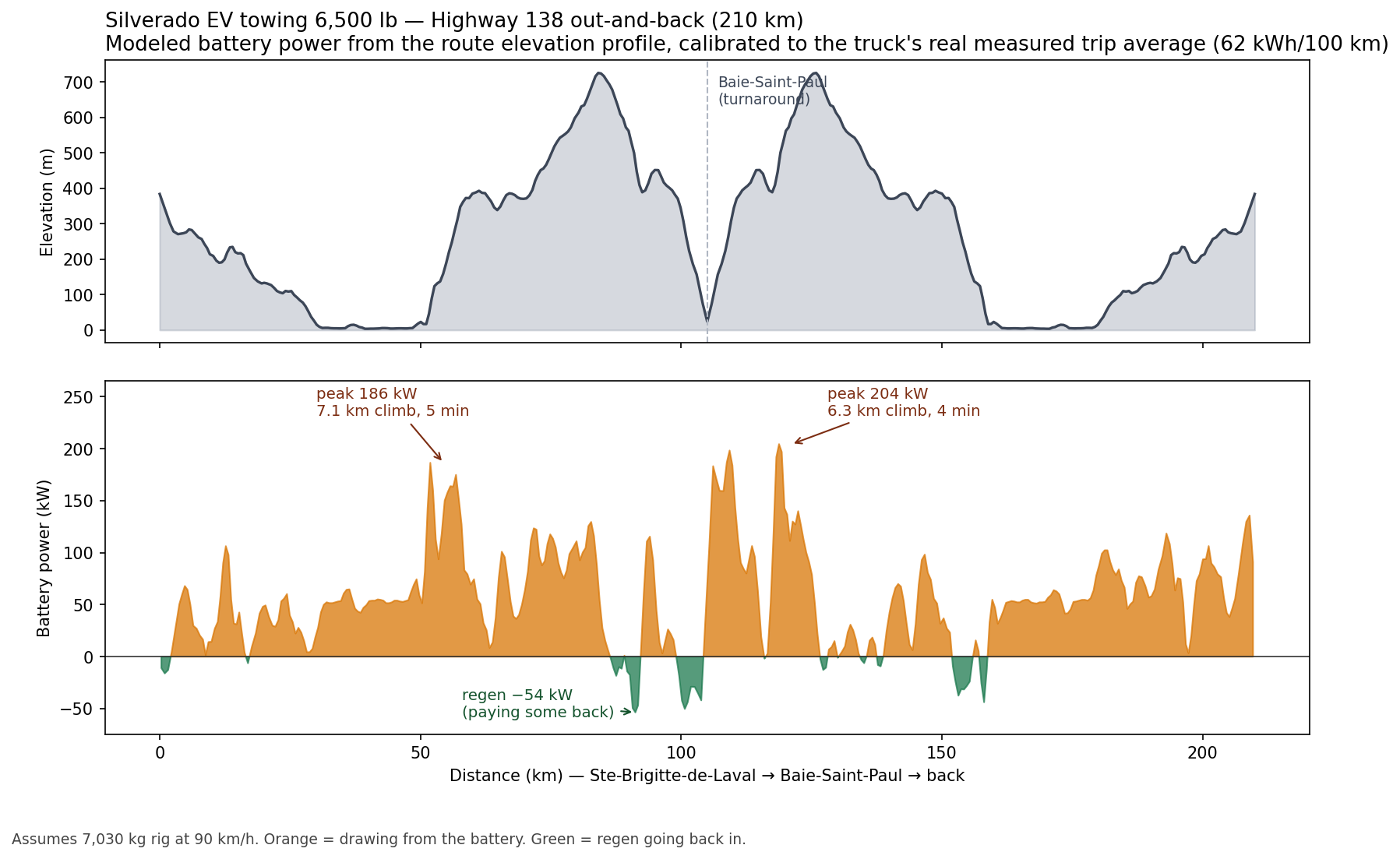
You've heard of TFL's Ike Gauntlet, billed as the world's toughest towing test because of its 7% grade at high altitude. Altitude matters to an engine that breathes. An electric motor doesn't breathe — what matters to it is gravity, and gravity is where Highway 138 through Charlevoix wins. The côtes on the run from Sainte-Brigitte-de-Laval to Baie-Saint-Paul pitch at 10%, with the steepest at 12%, one after another, for over 200 kilometres of up, down, up, down. Quebec law even makes trucks over three tonnes pull off for a mandatory brake check before the big descent. It was 5 to 8 degrees Celsius all day — cold enough to trim the regenerative braking and the range. If an EV tow rig has a weakness, this road finds it.
The Rig
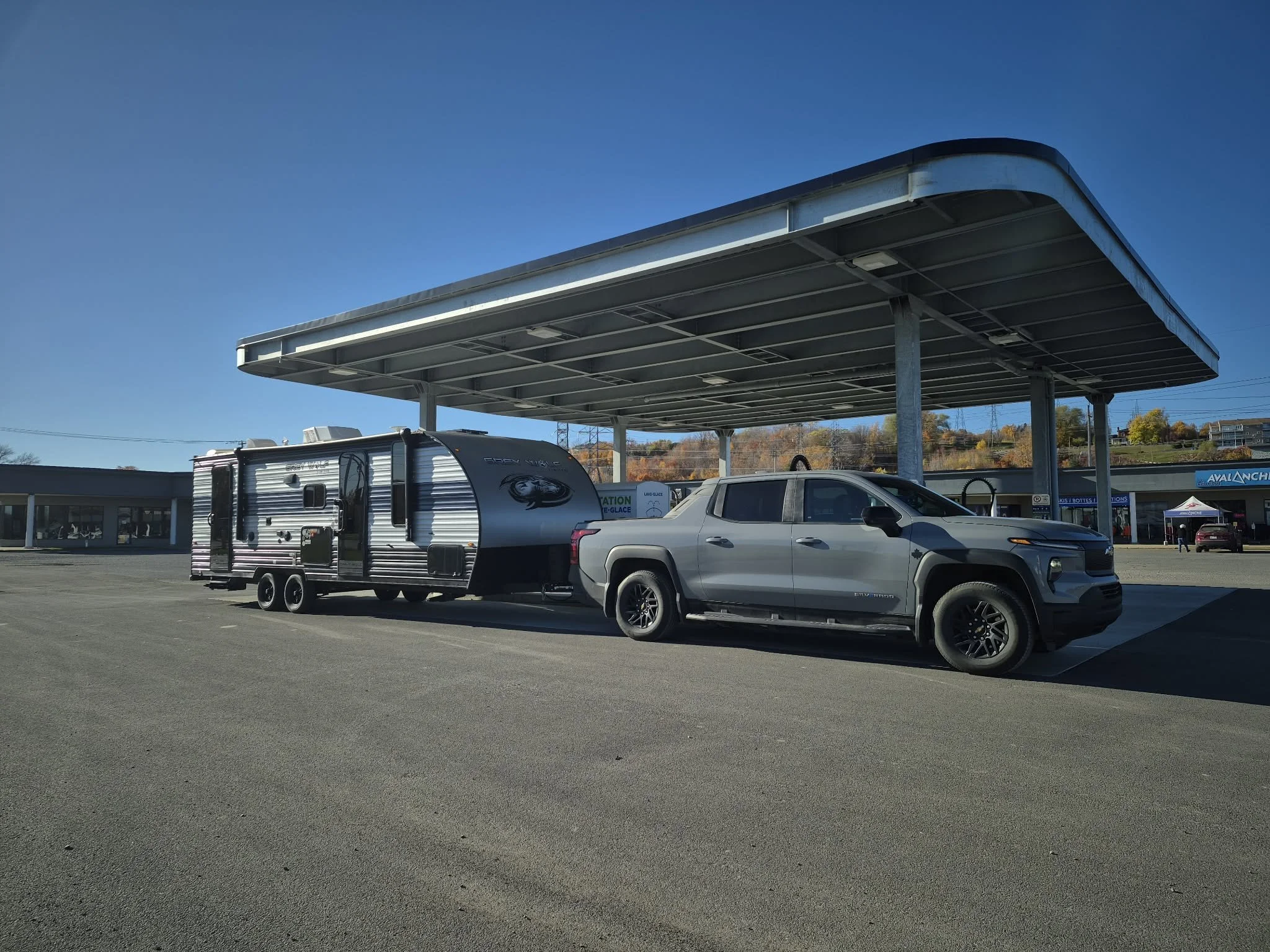
The truck is my 2026 Silverado EV Work Truck with the Extended Range battery — the one my business runs every day. The trailer is my friend Alex's 29-foot Forest River Cherokee Grey Wolf, loaded to 6,500 lb wet. Nothing exotic about the setup: a regular hitch with spring bars and a sway bar, the same rig you see in every campground in North America. The truck sat nearly level on it. Trailer brake gain set to 6, one-pedal driving on, trip meter zeroed, battery at 100%.
SPECS
2026 Chevrolet Silverado EV Work Truck, Extended Range
Powertrain: dual-motor electric, all-wheel drive
Output: 510 hp, 580 lb-ft
0–60 mph: about 5.8 seconds
Battery: 170 kWh
DC fast charging: up to 300 kW
Rated range, unloaded: 682 km (424 miles)
Maximum towing: 12,500 lb
Trailer as tested: 29-ft camper, 6,500 lb loaded
Observed consumption while towing: 62 kWh/100 km (1.6 km/kWh)
Projected towing range: about 279 km (173 miles)
Test conditions: 5 to 8 °C, grades of 10 to 12%
Driving It: The Part Nobody Else Shows You
Alex drove the first leg. He tows this exact trailer all summer behind his 5.3L V8 GMC Sierra, and he's a professional truck driver, so his comparisons carry weight. His first note, ten minutes in, was about the descents: the one-pedal system holds the whole rig back on its own. You don't set up for a hill, you don't ride the brakes, you don't feel 6,500 lb pushing you around. His words: you just feel nothing. Pure torque.
Then came the climbs. On a pitch Alex put at 11 to 12%, we were doing 100 km/h, accelerating, passing vehicles — in the fast lane, towing. Alex's estimate for his Sierra on the same hill: about 50 km/h, in the right lane, getting passed by everyone, and he wouldn't dare use cruise control because the V8 would hunt, rev, and drink. The Silverado's cruise not only held speed uphill, it visibly tempered its own acceleration because it knew it was towing.
I took the wheel for the return leg. Accelerating uphill from 90 to 100 km/h was a non-event. At one point I caught myself above the limit without realizing — the truck simply never sounds or feels busy. And the moment that says it all: a Ram 2500, not towing anything, foot to the floor trying to pull away from us uphill — and couldn't. We watched loaded semis crawling up those same grades at walking pace that this truck took at 110 km/h.
The Brake Scare
The test had one genuine moment of drama, and it wasn't the battery. We did our mandatory brake check before the big 10% descent — unlike the trucker behind us who blew straight through his, which is an infraction and, on that hill, a stupid one. Rolling away from the checkpoint, the dash lit up: "Trailer brakes disabled. Service required." Output zero.
Here's the interesting part: Alex felt no difference. The truck's regenerative braking was carrying the trailer's push by itself. At the turnaround we re-seated the trailer plug — a bad connection, nothing more — and the trailer brakes were back for the run home. Lesson worth the price of the whole test: on any truck, EV or not, check that plug before the côtes. Ours worked loose on a hard climb, and on a lesser setup that alert could have mattered a lot more.
The Charging Station of the Future
In Beaupré we stopped to look at something I didn't know existed yet: a pull-through charging station built for exactly this. Five stalls, up to 240 kW, a high canopy, drive straight in with the trailer on and straight out the other side. No unhitching in the back corner of a parking lot. This is what towing with an EV is supposed to look like, and it's already standing on Route 138.
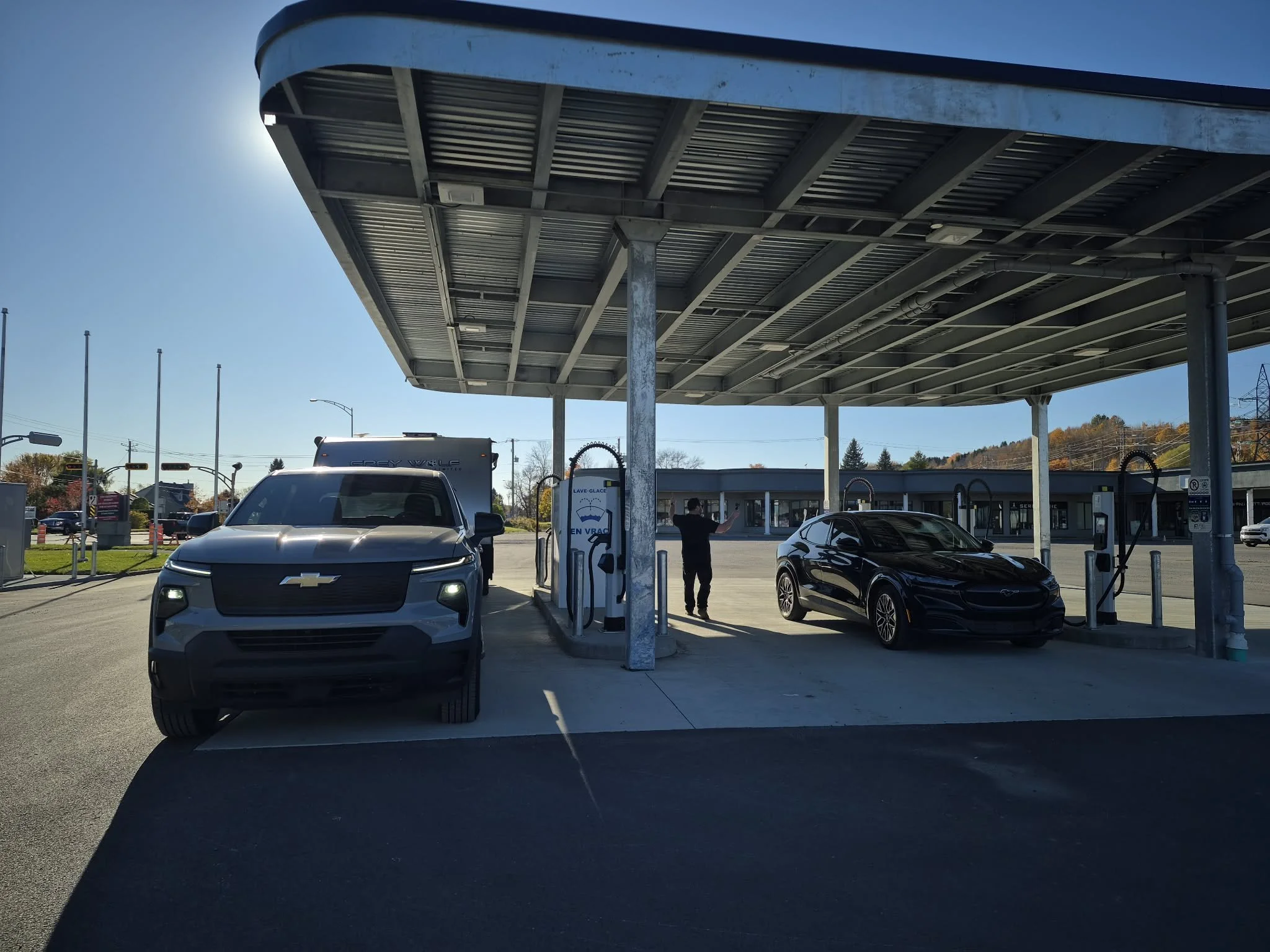
The best part? We didn't need it. We looked, we admired, and we drove home on the charge we started with.
The Numbers
We covered 223 km and rolled into the driveway with 20% battery and 56 km (35 miles) of indicated range left. Total it up and the truck projects to about 279 km (173 miles) — call it 280 — towing 6,500 lb in the cold, over 10 to 12% grades, driven hard. Consumption worked out to 62 kWh/100 km against a 682 km (424 miles) unloaded rating.
Now the ledger that actually matters: time. Alex figures his V8 would have burned about 29 L/100 km on this route and taken an hour to an hour and a quarter longer to drive it, because his truck climbs at half our speed. We banked that time on every hill. Which means the usual EV objection — "sure, but you'll lose it all at the charger" — doesn't survive this route. On a day longer than 280 km (174 miles), a roughly 45-minute charging stop would have been paid for entirely by the time the hills handed us back. On flat ground, that math flips, and I'll say so. On this ground, in these hills, the EV doesn't lose time. It just moves the stop.
The Math, in Plain English
This part isn't in the video, but a friend of mine earned it a place here — so, a shout-out to Critter. He tows with two diesels — a 3.0L and a 6.6L Duramax — and asked the fair question: okay, the EV is quick uphill, but what does a climb actually cost each truck, and is the range hit even proportionate? Here's the answer without the engineering degree.
Think of diesel and electricity as two different currencies, and this as the exchange rate. A litre of diesel holds about 10 kilowatt-hours of energy, but a diesel engine is a wasteful spender: out of every 10 units it burns, only about 4 actually reach the wheels. The rest leaves as heat. An electric motor is the opposite — about 9 out of every 10 units in the battery actually push the truck.
Convert everything into energy that reached the wheels and the picture flips. My Silverado ran this whole test on roughly the wheel energy of 14 litres of diesel per 100 km. Critter's 6.6L burns 18 L/100 km with his trailer on, and his 3.0L burns 38 — not because the trailer got heavier, but because a small engine working flat out wastes most of its fuel as heat. Same job, three very different fuel bills.
Hills are just lifting. Dragging a roughly 7,000 kg rig up a 400-metre climb costs a set amount of energy no matter what powers it — physics doesn't negotiate. The difference is the trip down: the EV claws part of that energy back through regen, like a partial refund. The diesel gets nothing back. Its exhaust brake turns all that energy into heat and throws it away.
And the range hit, done honestly, surprises people. Run the numbers on his trucks and mine, unloaded versus towing in hills: his 3.0L keeps only about 29% of its normal range. The Silverado keeps about 40%. His 6.6L keeps about 70% — mostly because it has a huge tank and an engine that's barely working. So the EV's real problem was never waste. Its tank is just small.
Pricing (Canada)
The 2026 Silverado EV lineup tops out well into six figures in RST and Trail Boss trims, but the Work Truck is the honest end of the range: Chevrolet Canada lists the Extended Range Work Truck at $80,470, and stickers on trucks actually sitting on dealer lots are landing around $77,799. For a truck that tows 12,500 lb, runs 682 km (424 miles) unloaded, and just did what this one did, that's the version of this truck that makes the most sense to me.
The Outsider’s Take

What I like:
- The climbs. Passing at 100 km/h on a 12% grade with 6,500 lb behind you is something no gas truck I've driven can do.
- You never feel the trailer. One-pedal driving and regen hold the whole rig on descents like an exhaust brake that also refuels you.
- It’s quiet, stable, and smooth — honestly, a whole different ball game from towing with a V8.
- Real range: about 280 km (174 miles) towing in the cold on the harshest terrain we could find, driven with zero restraint.
- Charging built for trailers is starting to exist — the Beaupré pull-through is the template.
What I don’t:
- The trailer-brake alert. A worked-loose plug killed our trailer brakes mid-test. The truck covered for it, but check your connection before the hills.
- The cold trims your regen — under 10 degrees Celsius you don't get all of it back on the way down.
- I wanted 300 km (186 miles) and got about 280 km. Plan a winter towing day around that number, not the brochure.

Alex tows that trailer all summer for a living-adjacent hobby, and his verdict on the driving was "a thousand times better" than his V8. Is he buying one? "Not yet." Fair enough — but here's where I've landed: for towing days inside this truck's range, on terrain like this, the electric truck isn't the compromise anymore. The gas truck is the one asking you to slow down, stay right, and take an hour longer. We didn't compromise a single kilometre of this drive, and the clock at the end said we didn't have to.
