

I first saw this one at its launch last winter — the first launch event I'd ever been invited to — and I liked what Mitsubishi had done with it. I'd also reviewed the previous model year, so when the refreshed 2026 Outlander PHEV GT came to me for a full week, I knew exactly what to look for: did they fix the right things, and did they leave the good stuff alone?
Short answer: yes on both counts. This is a mid-cycle refresh done properly. The Outlander PHEV is Canada's best-selling plug-in hybrid, and instead of reinventing it, Mitsubishi gave it a bigger battery, more power and a round of small, smart interior fixes. After a week with it, I get why it sells. It's also not perfect — and the flaw is one you'll never spot on a spec sheet.
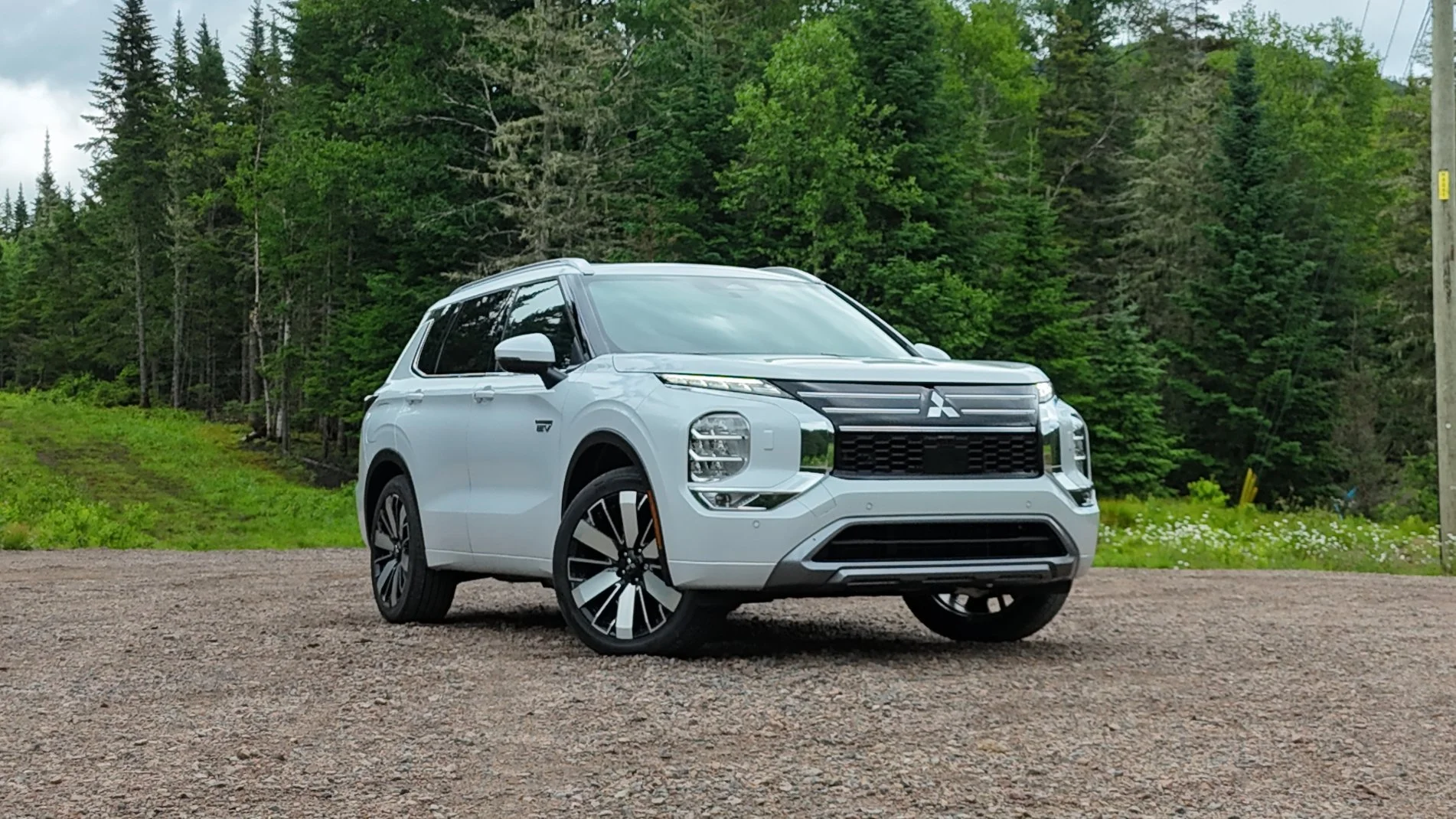
WHAT’S NEW FOR 2026
Battery grows from 20 kWh to 22.7 kWh, using new prismatic cells and improved cooling — about 30% more capacity in the same space, and the pack can deliver roughly 60% more power
Electric-only range climbs from 61 km (38 miles) to 72 km (45 miles); total range is now 690 km (420 miles)
Total system output jumps from 248 hp to 297 hp
Combined fuel economy improves to 3.2 Le/100 km, and gas-only economy to 8.6 L/100 km (27 mpg US) city and highway
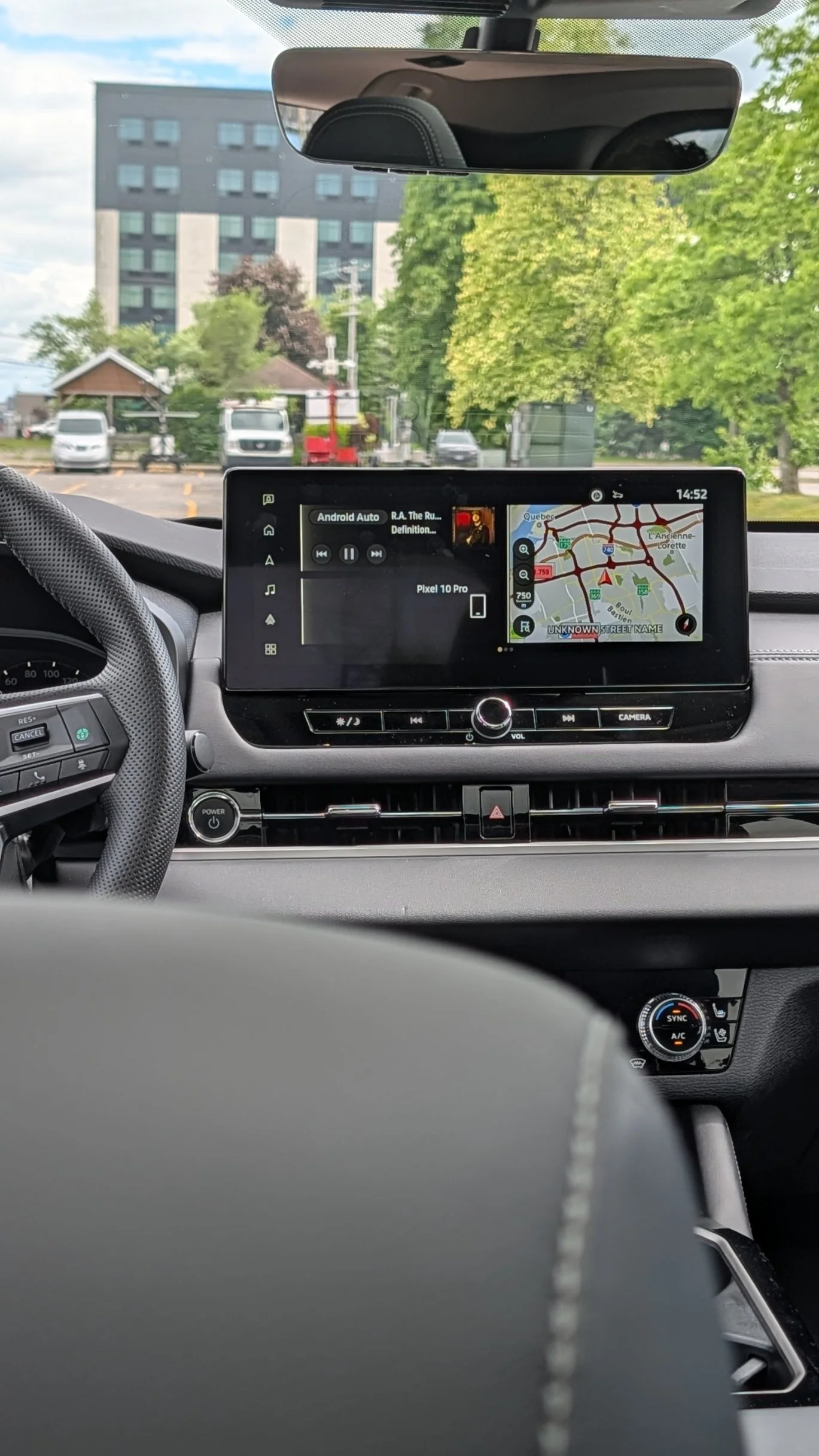
Larger 12.3-inch infotainment touchscreen, revised front and rear bumpers, new wheel designs
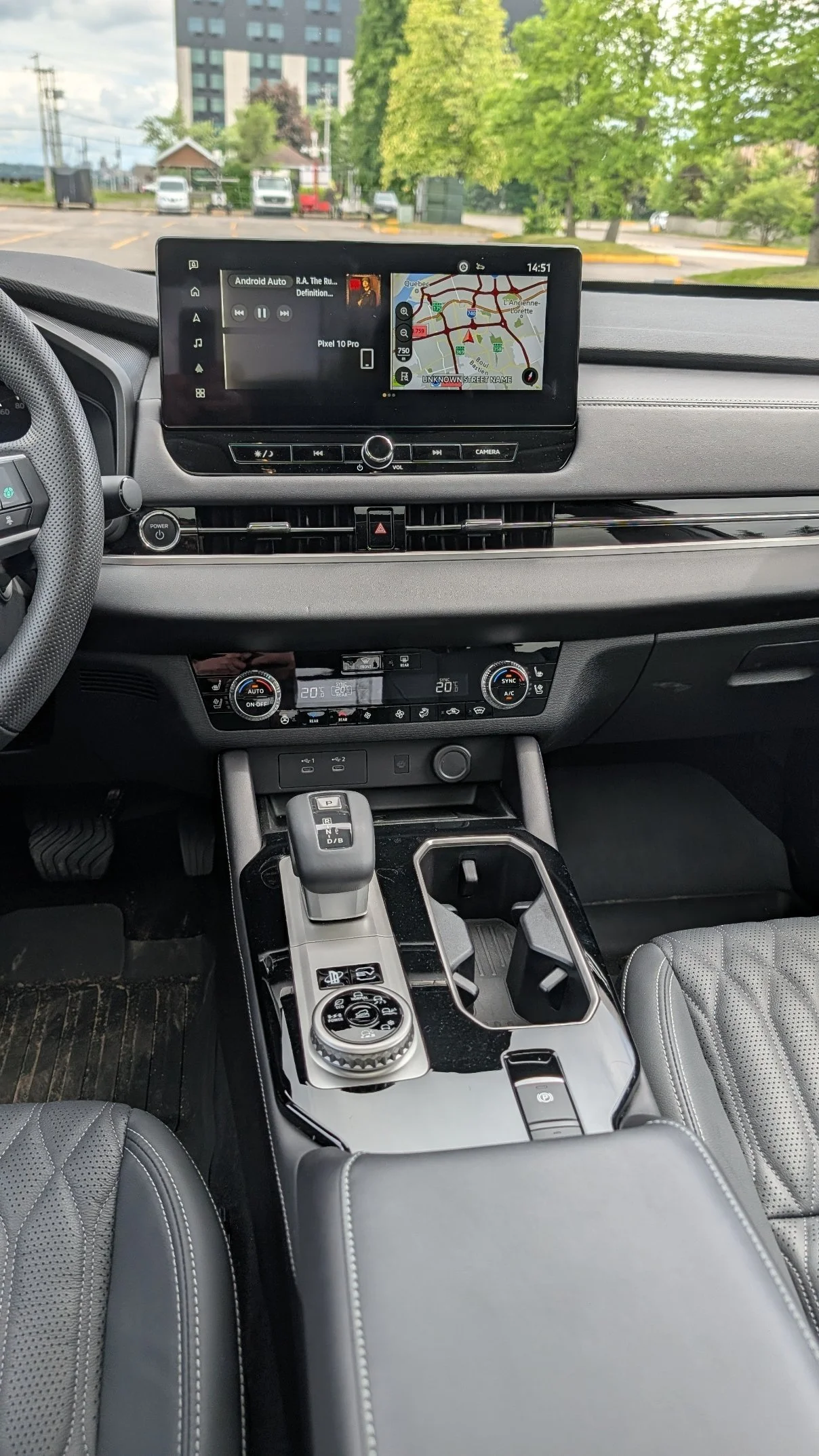
Redesigned centre console with about 45% more storage, reworked cupholders and wireless charging pad
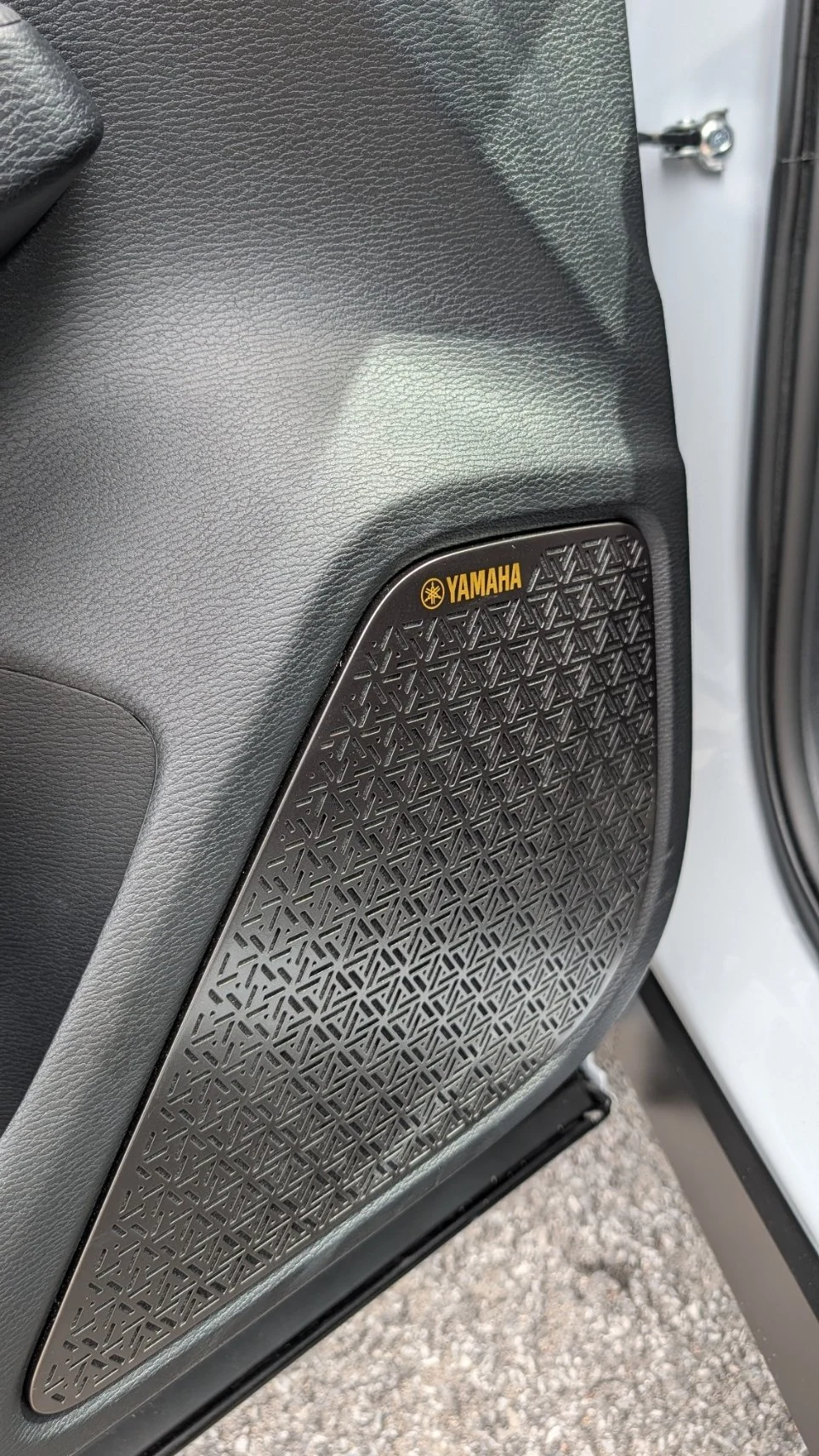
Retuned steering and suspension; Dynamic Sound Yamaha audio now on every trim in Canada
SPECS
Powertrain: 2.4L 4-cylinder + two electric motors (front and rear), single-speed transmission
Output: 297 hp; 332 lb-ft of torque (system figure — Mitsubishi doesn't publish an official torque number)
Drivetrain: Super All-Wheel Control (S-AWC), standard on all trims
Battery: 22.7 kWh lithium-ion
Electric-only range: 72 km (45 miles)
Total range: 690 km (420 miles)
Fuel economy: 3.2 Le/100 km combined (73 MPGe); 8.6 L/100 km (27 mpg US) gas-only
Charging: Level 2, about 6.5 hours; DC fast charging (CHAdeMO) to 80% in about 29 minutes
Towing: 1,500 lb
Payload: 1,554 lb (as tested)
Cargo: 12.8 cu ft behind the third row; 30.8 cu ft behind the second row; 60.7 cu ft with both rows folded
Seating: 7
Price: from $49,998 (ES); GT $60,598; this tester about $62,000 as tested
The Outside
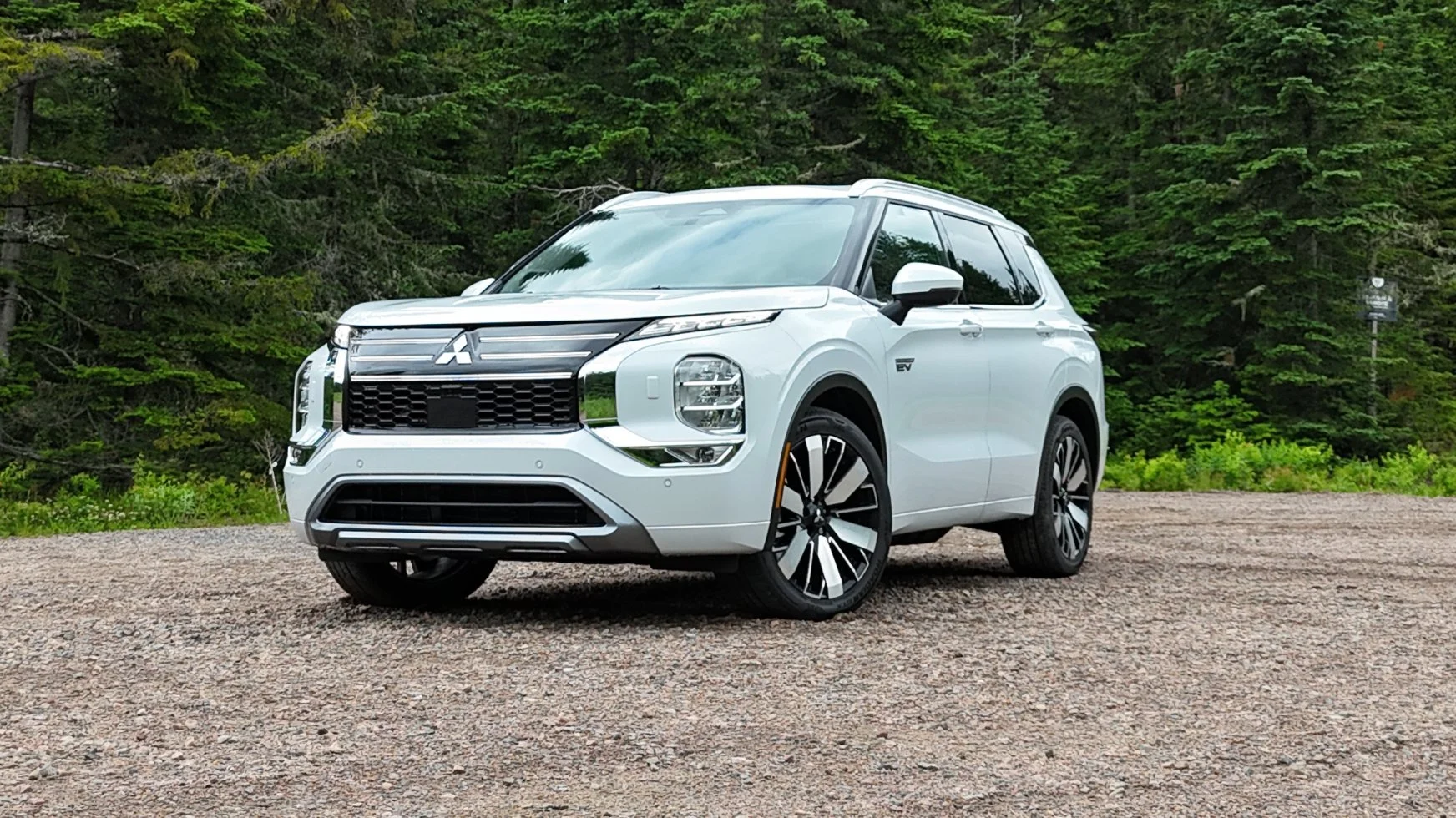
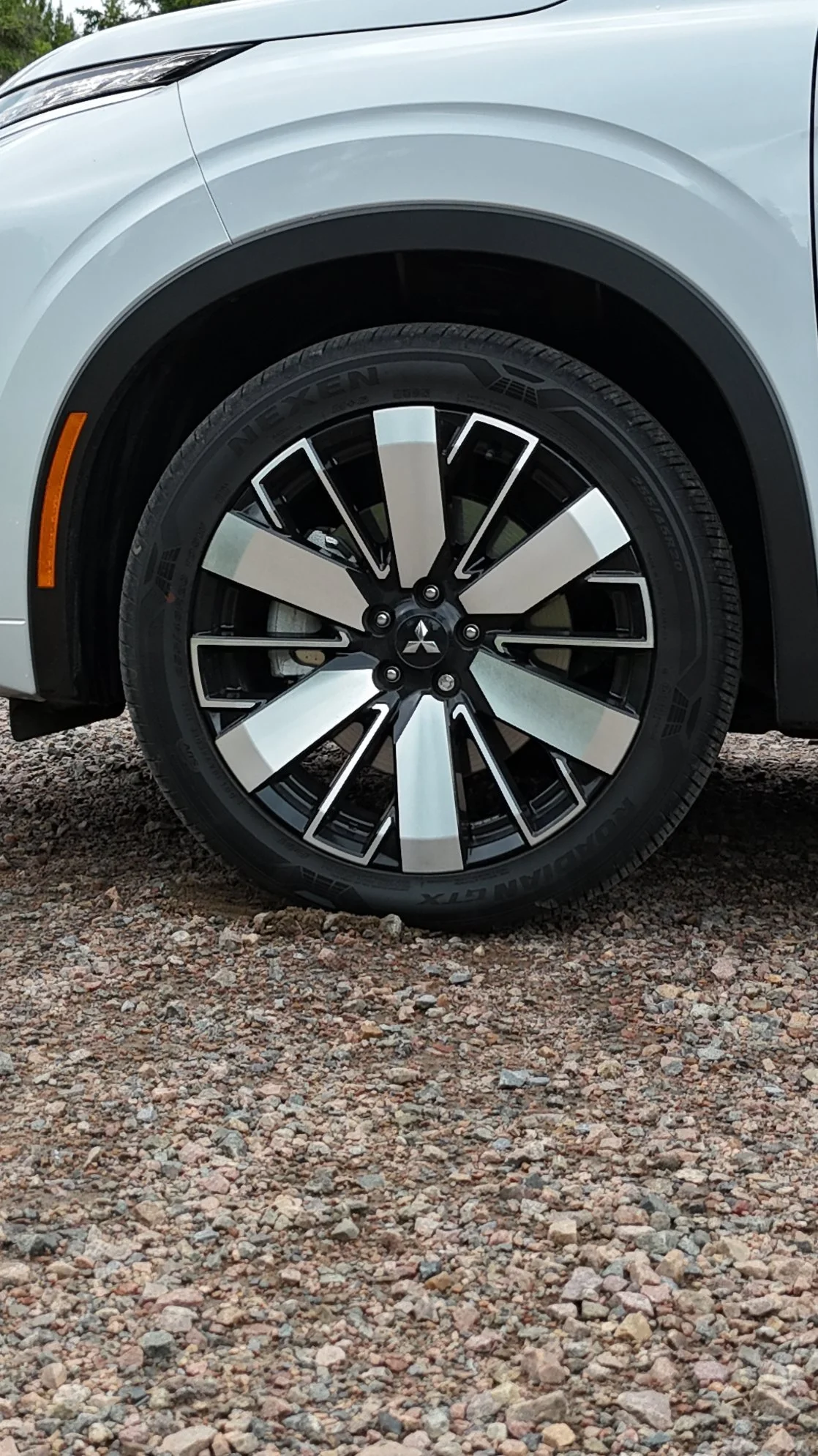
The front fascia is tweaked, not transformed — a blacked-out grille treatment with a bit of chrome on this GT. Step up to the Noir package and everything blacks out further, wheels included. I liked the old face, so I'm glad they didn't mess with it. The new 20-inch wheels wear 255/45R20 tires and get a fresh pattern this year, and there's a 360-degree camera system, with cameras in the grille and under the mirrors.
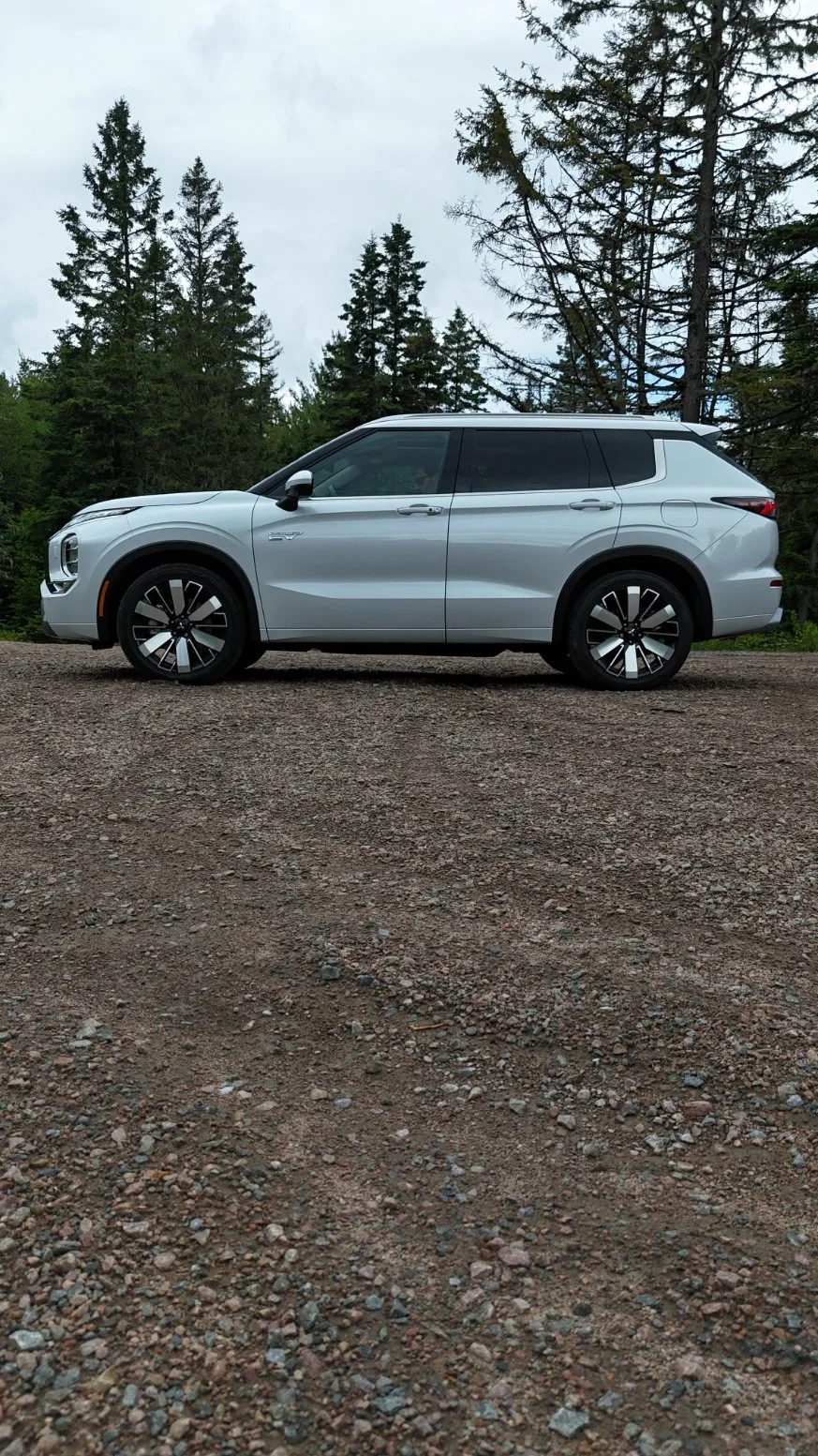
Size-wise, this is a proper midsize: at 185.8 inches long it's a touch bigger than a Chevrolet Equinox (183.2 in), and well short of a Traverse (204.5 in). That footprint is how it fits three rows — more on whether you should use all three in a minute.
It’s Really a Range-Extended EV
Here's the thing most people get backwards about this vehicle. On most hybrids, the gas engine does the driving and the electric motors help out. Here it's the opposite: the two electric motors do the driving, front and rear, and the 2.4-litre engine's main job is generating electricity for the battery. That's why the transmission is a single speed, and it's why the whole thing feels so smooth — you're driving an EV, and the engine is mostly along to feed it. Only in Power mode does the engine also pitch in directly to help drive. I think of it as a range-extended EV wearing a plug-in hybrid badge, and once you drive it that way, it makes complete sense.
Charging: One Party Trick, One Real Complaint
The Outlander PHEV is one of the only plug-in hybrids that can DC fast charge at all, and it does it well: about 29 minutes to 80% on a CHAdeMO charger, at up to 50 kW. The catch is the plug itself. CHAdeMO is a standard the industry is walking away from as everyone moves to NACS, so those chargers are getting harder to find. I'd like to see Mitsubishi move to NACS on the next one. For now, treat fast charging as a bonus, not a plan.
The home charging is the real disappointment. A full charge on Level 2 takes about six and a half hours — for a 22.7 kWh battery. My Equinox EV has an 85 kWh battery and charges in about the same time. The bottleneck is the onboard charger, which only sips power at roughly 3.6 kW no matter how strong your home station is. I learned this the annoying way: my sister bought a 2026 Outlander PHEV Noir — the top trim — plugged it into my Level 2 at home, and I expected it to top up in about two hours over dinner. Six and a half hours later, it was still going. She did not leave with a full battery. For a vehicle whose whole point is running on electricity, Mitsubishi could and should make this faster.
Cargo and the Third Row
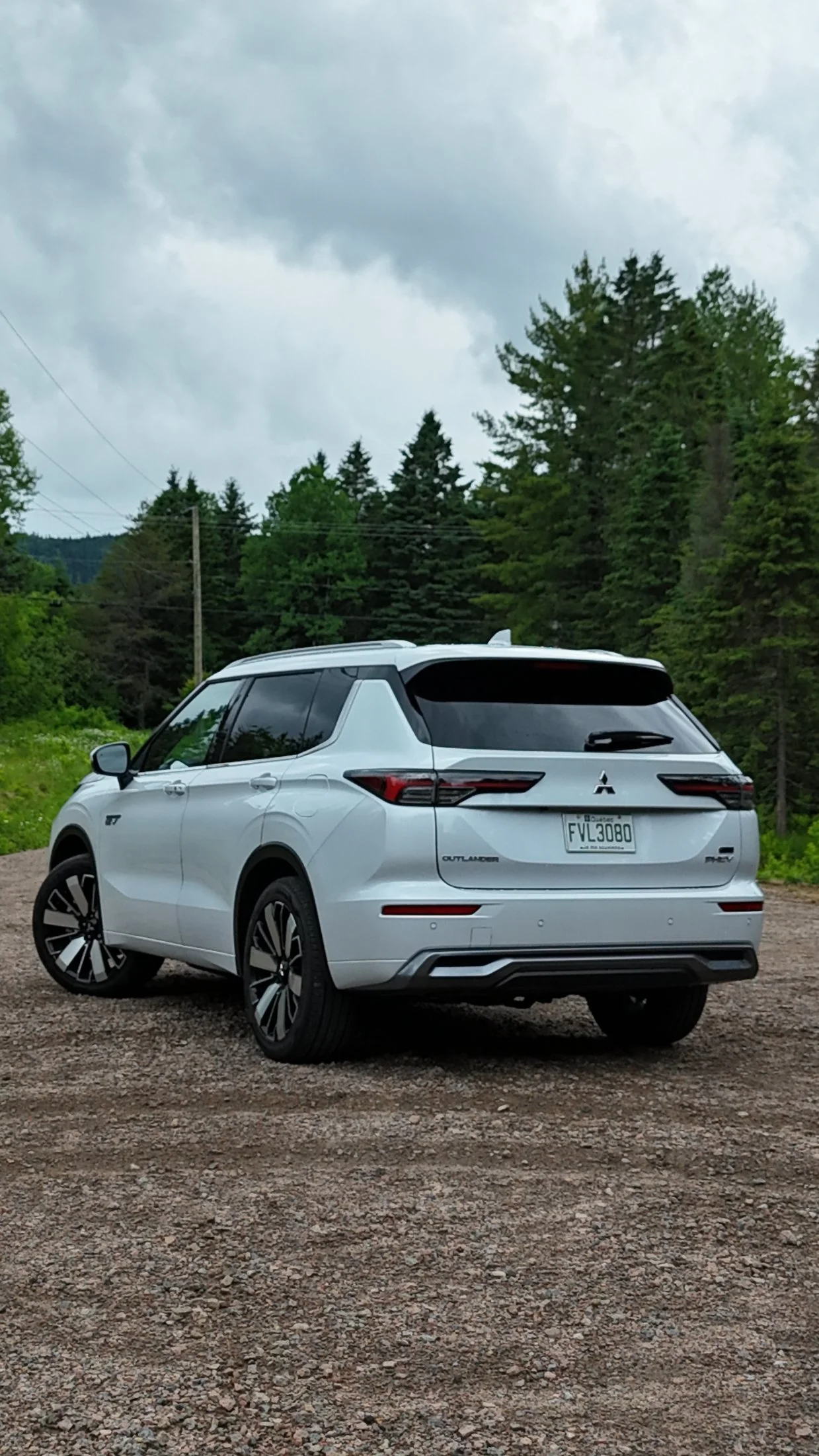
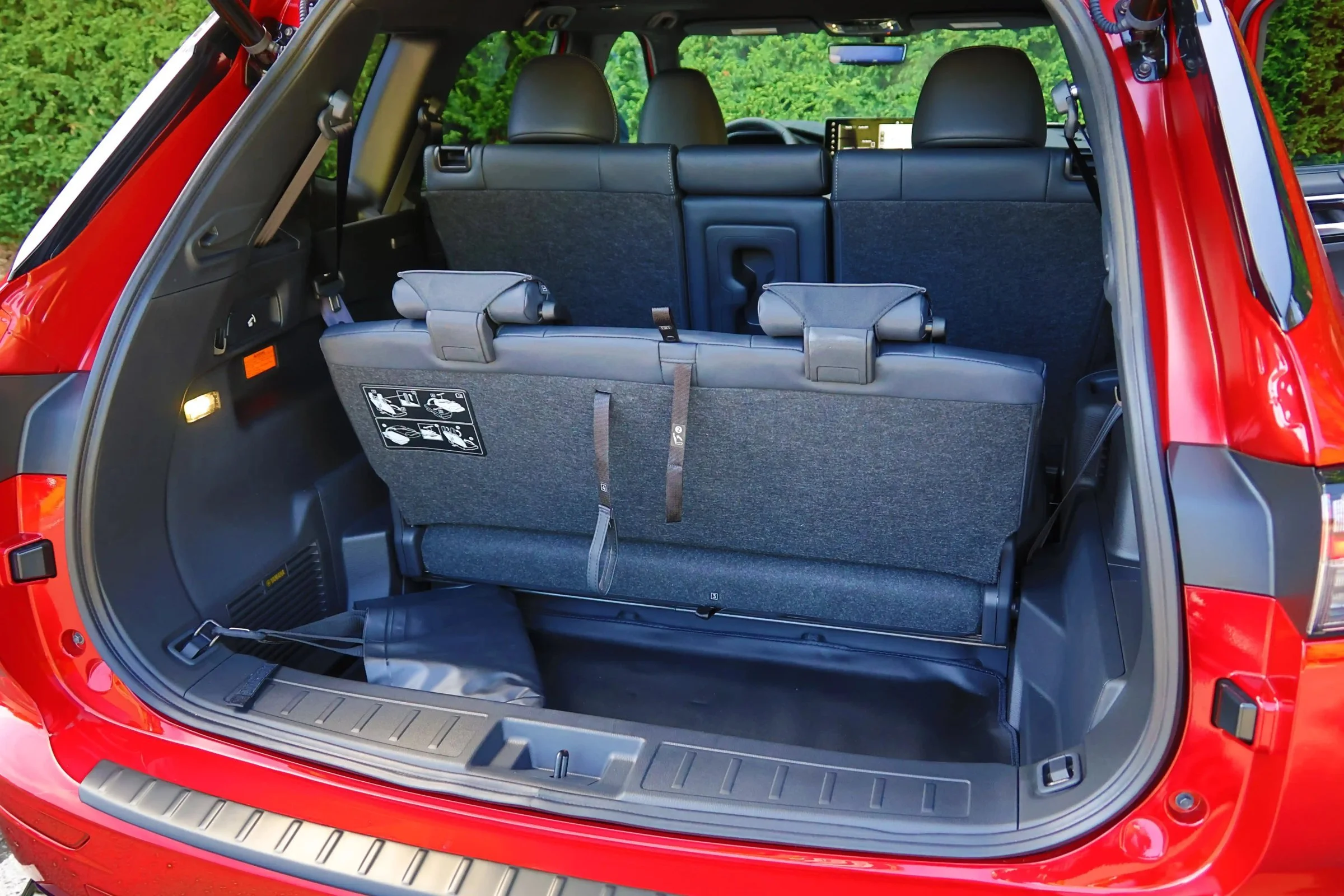
Open the power hatch and you get 12.8 cubic feet behind the third row — a deep, usable well, with a spare tire and a tire repair kit under the floor and a 150-watt household outlet back there. Fold the third row and it's 30.8 cubic feet; fold the second row too and you're at 60.7. The second row's fold-down centre armrest doubles as a proper pass-through for skis or hockey sticks, like you get on a Volvo or a Volkswagen — not just cupholders blocking the hole. Smart.
The third row itself is where reality checks in. Legroom back there is 18.7 inches, and instead of squeezing myself in, I had my nine-year-old, Loïc — who was also my cameraman for this one — try it. It's tight even for him, and when I asked if he'd want to do a three-hour trip back there, his answer was no. Mine too. This third row is an emergency-and-short-hop row, for kids only. Treat the Outlander as a very good five-seater that can pinch-hit as a seven-seater, and you'll be happy.
One more third-row note, and it's the seed of my biggest complaint: those tall third-row headrests block your rear view in the mirror when the row is up. Fold it down,
though, and visibility is genuinely good, with very few blind spots.
The Cabin: Legitimately Luxury-Leaning
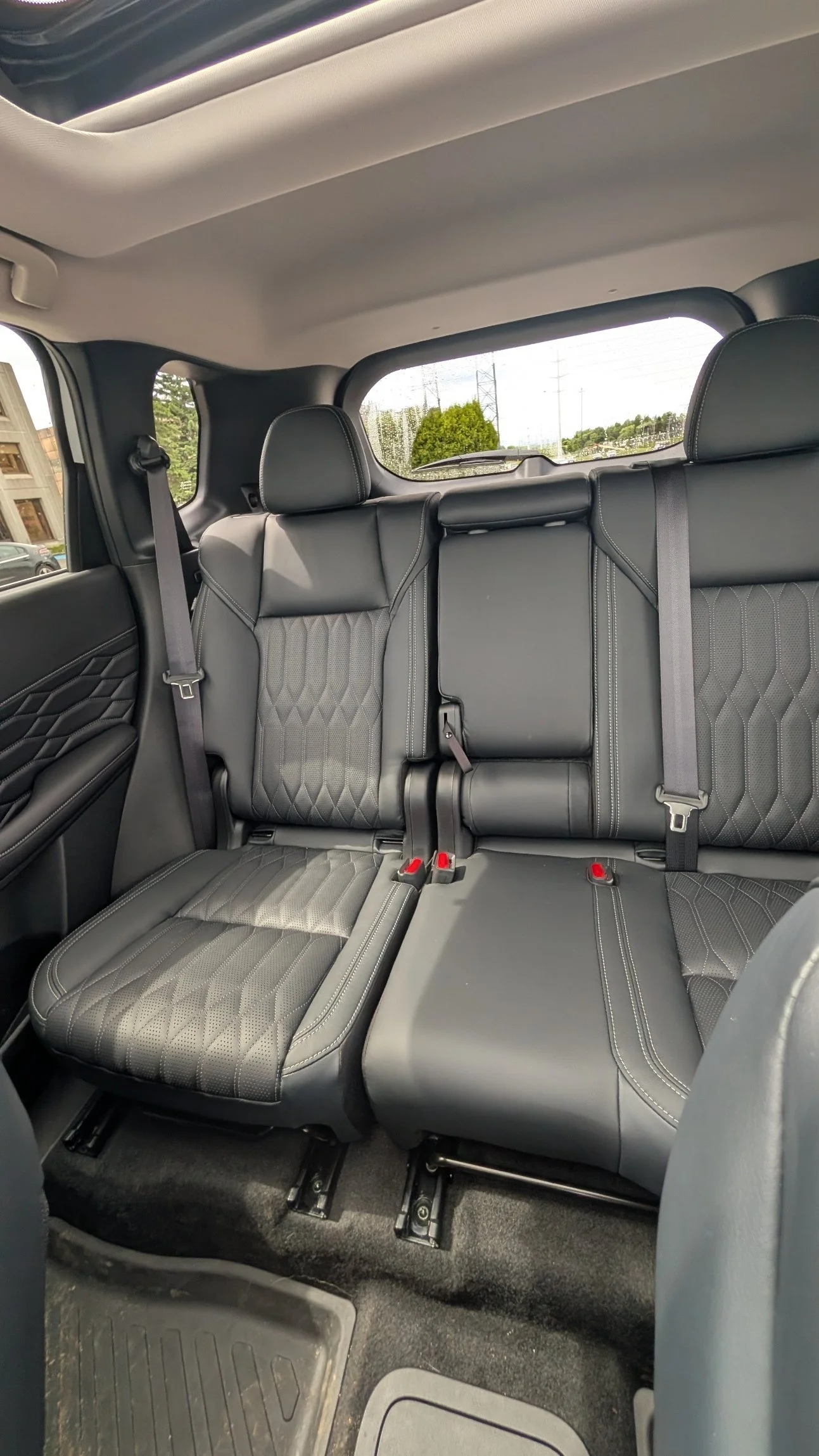
The second row is where this interior earns its money. There's 37.6 inches of legroom, my feet slide under the seat ahead, the cushions are extremely soft, and the quilted, padded door trim feels like it belongs in a luxury segment. It honestly reminded me of the Nissan Pathfinder I reviewed recently — that's the comfort class we're talking about. The outboard seats are heated (not ventilated — can't have everything at this price), they recline, and there's tri-zone climate control.
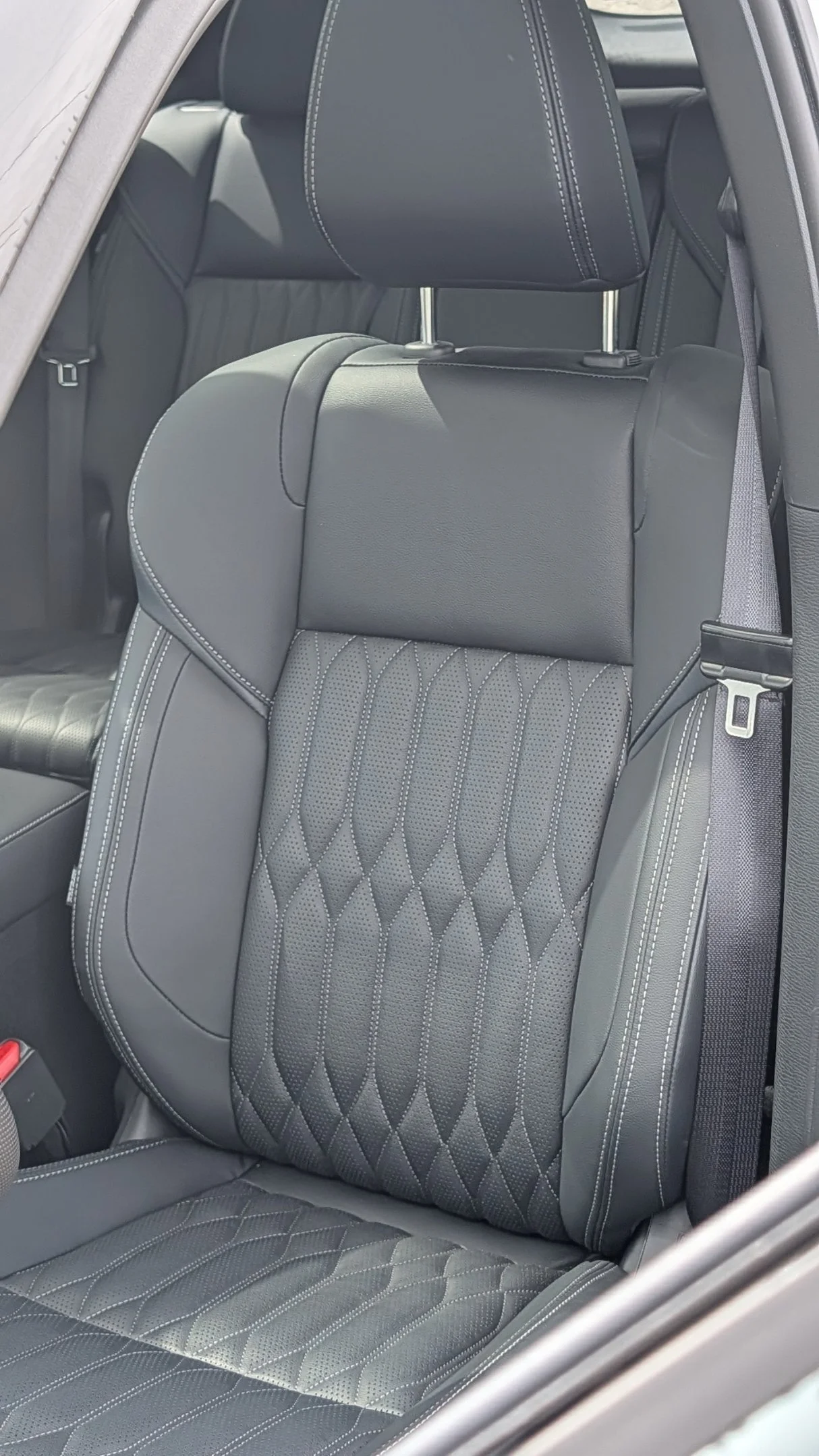
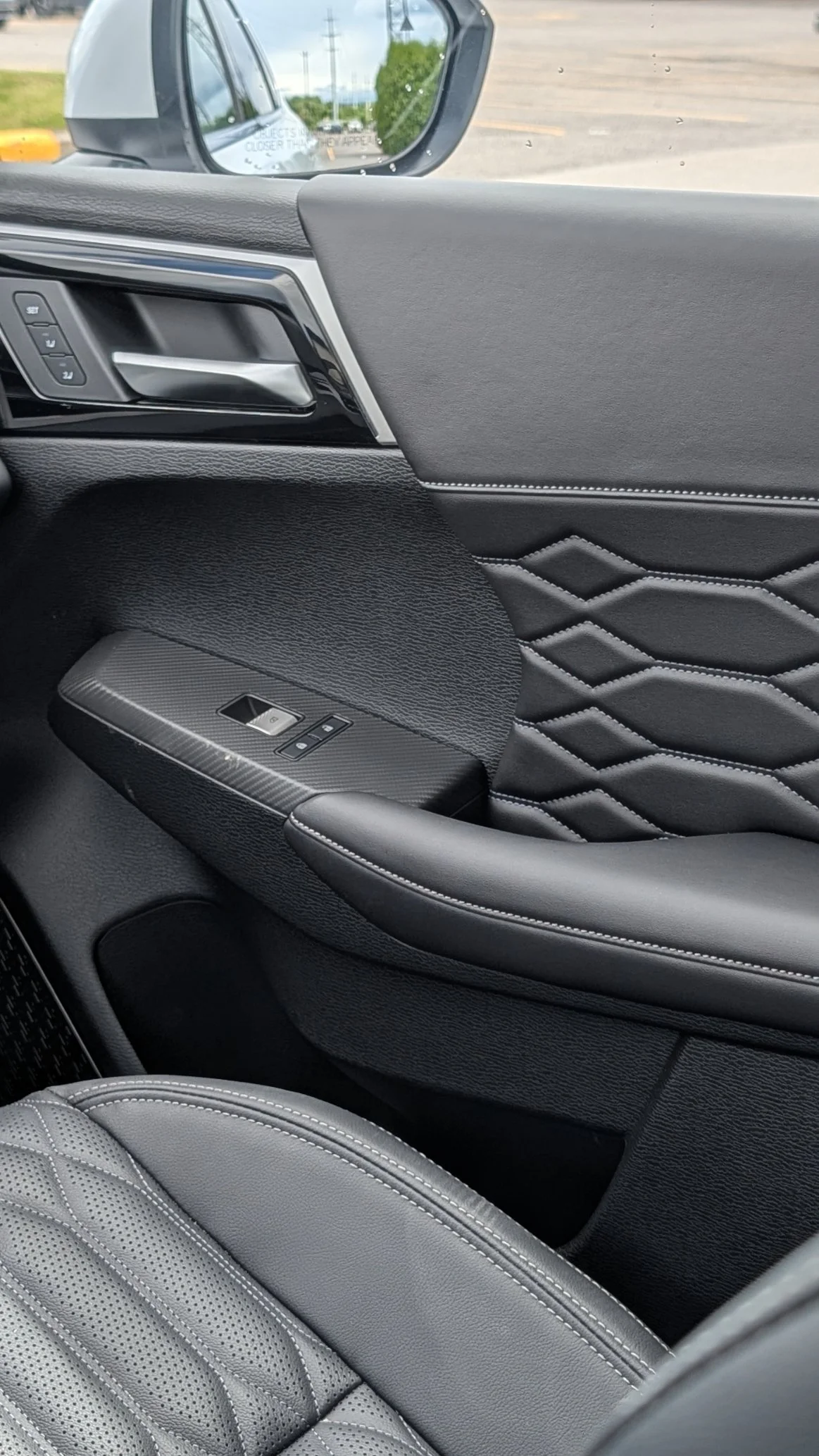
Up front it's more of the same: quilted, soft materials everywhere, memory settings for both front seats — driver and passenger, which is rare — heated and ventilated front seats, and a heated windshield. Mitsubishi won awards for this interior a couple of years ago, and the refresh respects why. The new, bigger screen responds quickly, wireless Apple CarPlay and Android Auto work properly, and the 360-camera image quality is excellent — nothing like the screen in the Eclipse Cross, which I had real issues with. The climate controls are still knobs and buttons, the way they should be. The Yamaha sound system is one of the best I've heard in this class, full stop.
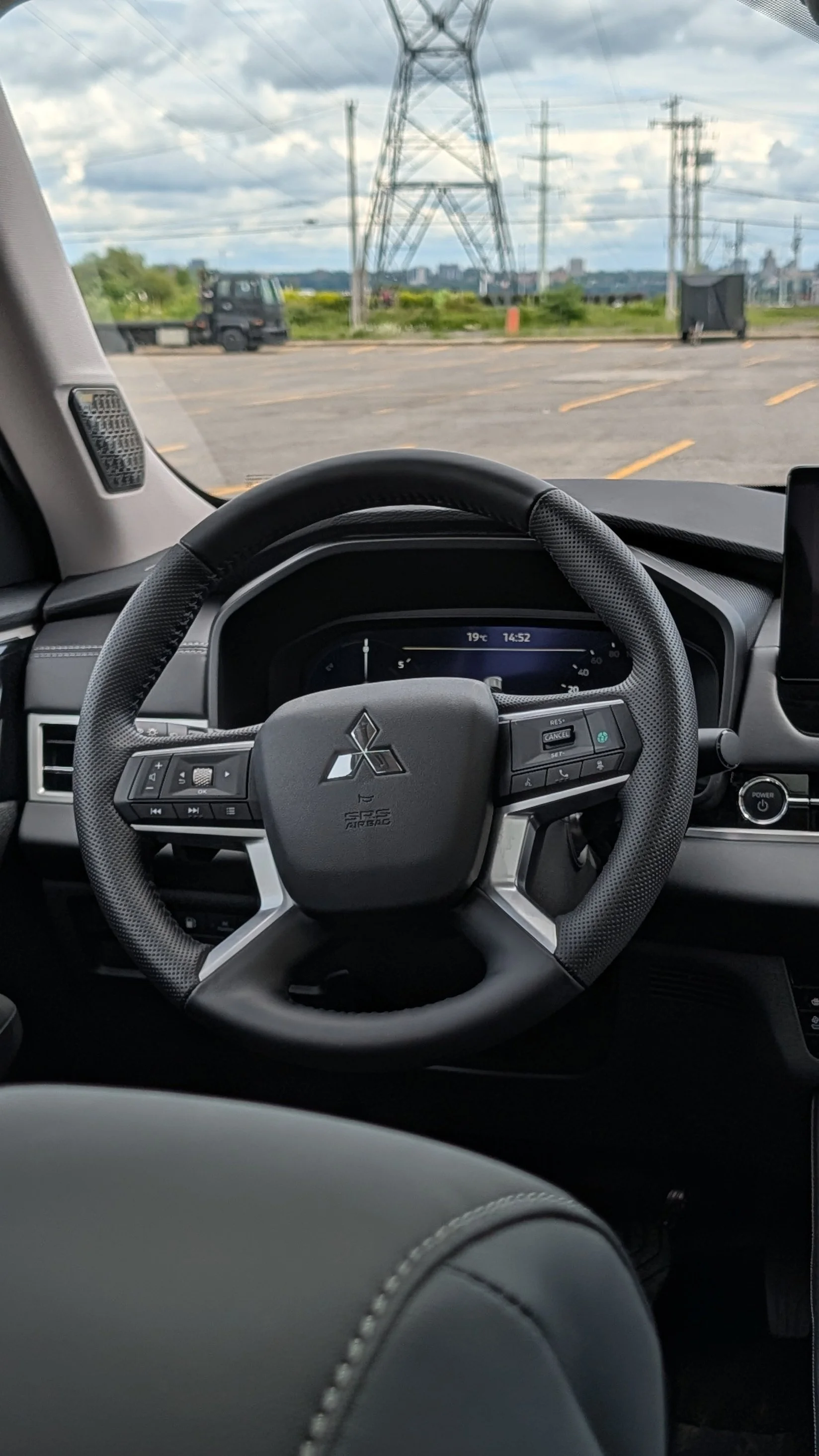
The driver-assistance setup will feel familiar to Nissan drivers: adaptive cruise with lane centering and lane keeping, very much in the ProPILOT family of systems. It works well, but it is not hands-free — hands stay on the wheel.
Seven Drive Modes, and They Actually Differ
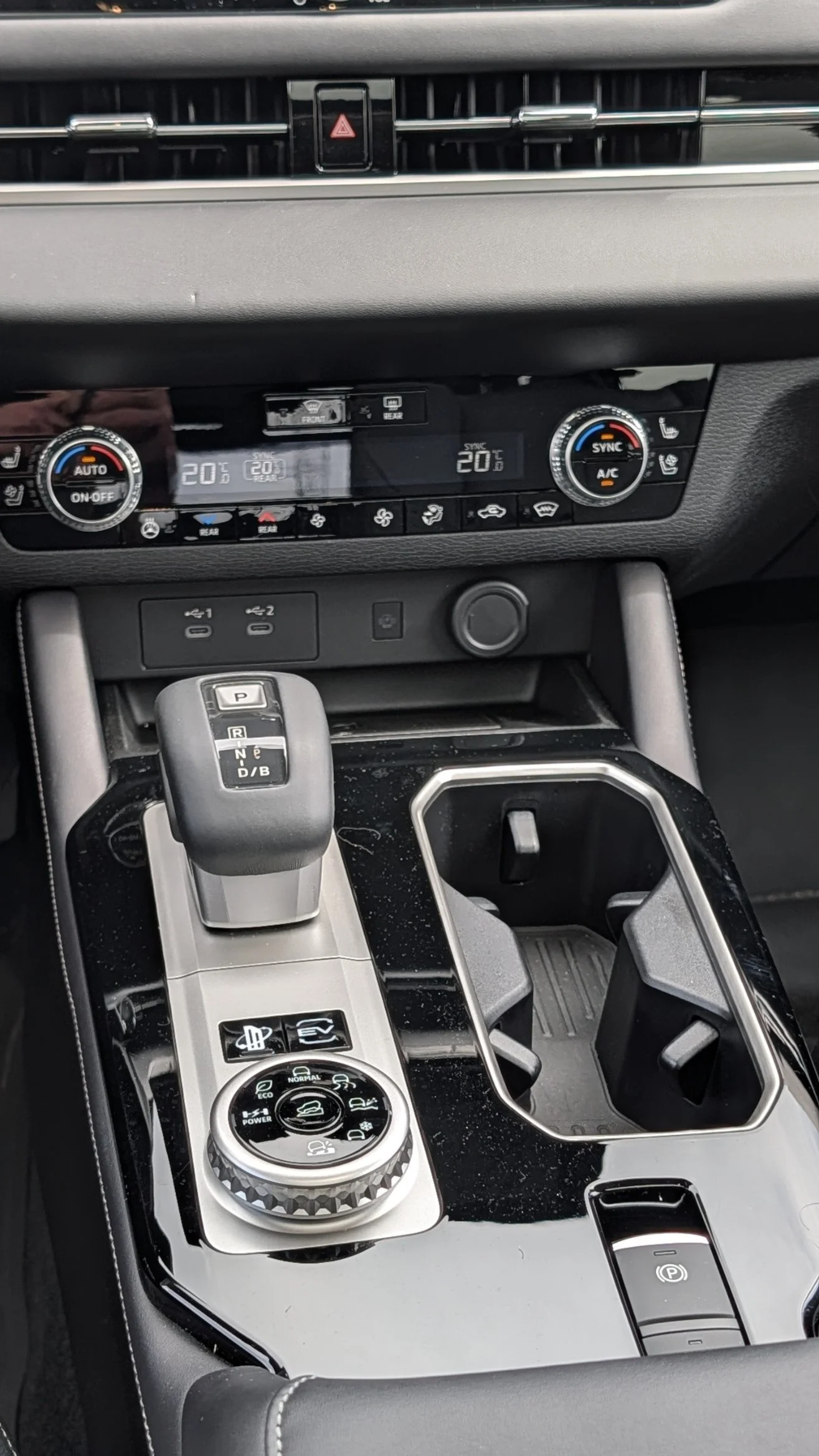
The mode dial gives you Normal, Eco, Tarmac, Gravel, Snow, Mud and Power, plus EV settings that let you run purely electric, save the charge for later, or have the engine charge the battery as you drive. The paddles behind the wheel adjust regenerative braking instead of gears — my one small gripe there is that the regen steps aren't as predictable as a full EV's.
What surprised me is how much the modes actually change the vehicle. In some SUVs the modes are a placebo. Here, Power mode brings the engine in alongside the motors and the thing genuinely hustles — there's a lot of torque to play with. Tarmac mode, which comes out of Mitsubishi's rally heritage, keeps the electric motors doing the work with the engine generating, sharpens the steering and feels more balanced and agile. Normal mode, by comparison, is tame to the point of feeling like a different vehicle. The retuned suspension keeps body roll in check and swallows bumps well, even on those 20-inch wheels.
And it is quiet. Even with the engine revving hard under load, you barely hear it. I'll say it plainly: a Toyota RAV4 Plug-In Hybrid is not going to be this quiet, or this comfortable, or this well equipped inside.
The Numbers From My Week
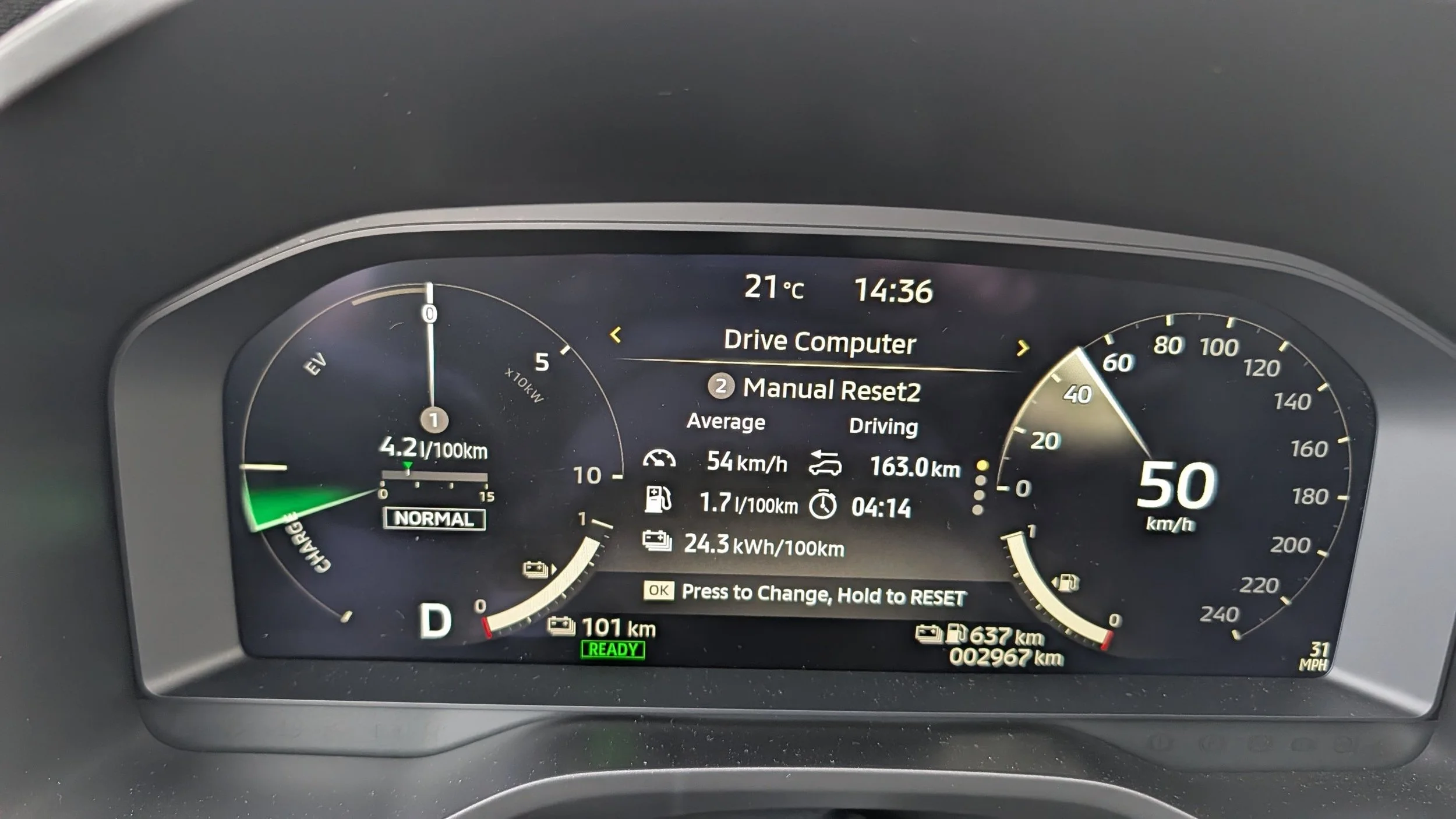
With the battery kept charged, this thing sips. After my reset, the tester showed 1.5 L/100 km over mixed driving, and even after I spent a drive deliberately beating on it in Power and Tarmac, it had only climbed to 1.8 L/100 km. (Those are the kind of figures where the US conversion stops meaning anything — most of those kilometres were electric.) The rated gas-only number, once the battery is empty, is 8.6 L/100 km (27 mpg US), and on the highway with a dead battery your economy does suffer — plan around the plug and you'll rarely see it.
On electric range, trust the 72 km (45 miles) rating as a floor, not a ceiling. Driving it hard, my indicated range dropped to 68 km; owners report seeing around 80 km; and at one point, between the regenerative braking and coming down out of the mountains where I live, the vehicle was showing me over 100 km of electric range. Seventy is the honest everyday number, with real headroom above it.
The RAV4 Question
I drew comparisons to the RAV4 Plug-In Hybrid all week, so let's settle it here. On paper, Toyota counters with a longer 81 km (50 miles) electric rating, and I'll concede the other point people always raise: the RAV4 will hold its resale value better. That's perception and market, and it's real. What I evaluate is the product in front of me — and here's the difference nobody puts on a spec sheet: you can actually buy this one. Wait times on a RAV4 Plug-In Hybrid run six months or more. The Outlander PHEV is on dealer lots now. It's also worth knowing its twin just arrived wearing a Nissan badge: the new Rogue PHEV is this same vehicle, but with last year's smaller battery and 248 hp. The Mitsubishi is the updated one.
On price, the lineup starts at $49,998 for the ES — the only trim that slips under the federal $50,000 cap and qualifies for the $2,500 EVAP rebate — with this GT at $60,598, the GT Premium at $61,698 and the Noir at $63,048. My tester sat at about $62,000 as tested. Mitsubishi also backs it with a 10-year/160,000 km powertrain warranty, which matters on a vehicle with this much going on under the floor.
The Outsider’s Take
I absolutely love this thing. Luxury-grade interior, a genuinely great sound system, silence like a full EV, real performance when you ask for it, and electric range that covers most people's daily driving — for under $65,000 Canadian, in a vehicle you can buy today. My sister bought one after seeing it, and after my week, I understand why.
My con list is short, but it's real, and it all comes down to air. There is effectively no ventilation for the third row or the cargo area — the vents that exist are small, low, and partly blocked by the second-row seats. My sister noticed it because her dog rides in the back and it gets hot back there; put kids in that third row on a summer day and you'll be cranking the air conditioning for the whole vehicle just to keep them comfortable. If Mitsubishi is going to sell a three-row SUV, the third row deserves vents — ideally up high, where the air can actually reach. Add the slow home charging as a lesser gripe, and that's the whole list.
Almost perfect, then. Fix the airflow, speed up the charger, and I wouldn't have anything left to complain about.
