

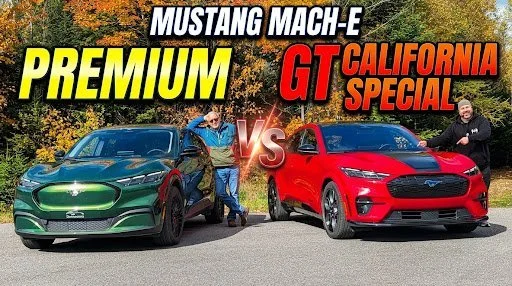
Companion to the video: Same Car, Totally Different Animal? Mach-E Premium vs GT (https://youtu.be/EE0ubh-1VVA)
Luc calls his Premium a beast. Then he drove the GT California Special and called it a beast 2.0. That one line is basically this whole comparison. Same car, same shape, same badge on the nose — and a completely different animal once you drive them back to back.
The two cars in this test: Luc's 2026 Mustang Mach-E Premium with the standard-range battery, and the 2026 Mustang Mach-E GT California Special I reviewed separately, with the GT Performance Upgrade. Everything below is what we found driving them together, plus the pricing.
Exterior: the GT looks like it means it
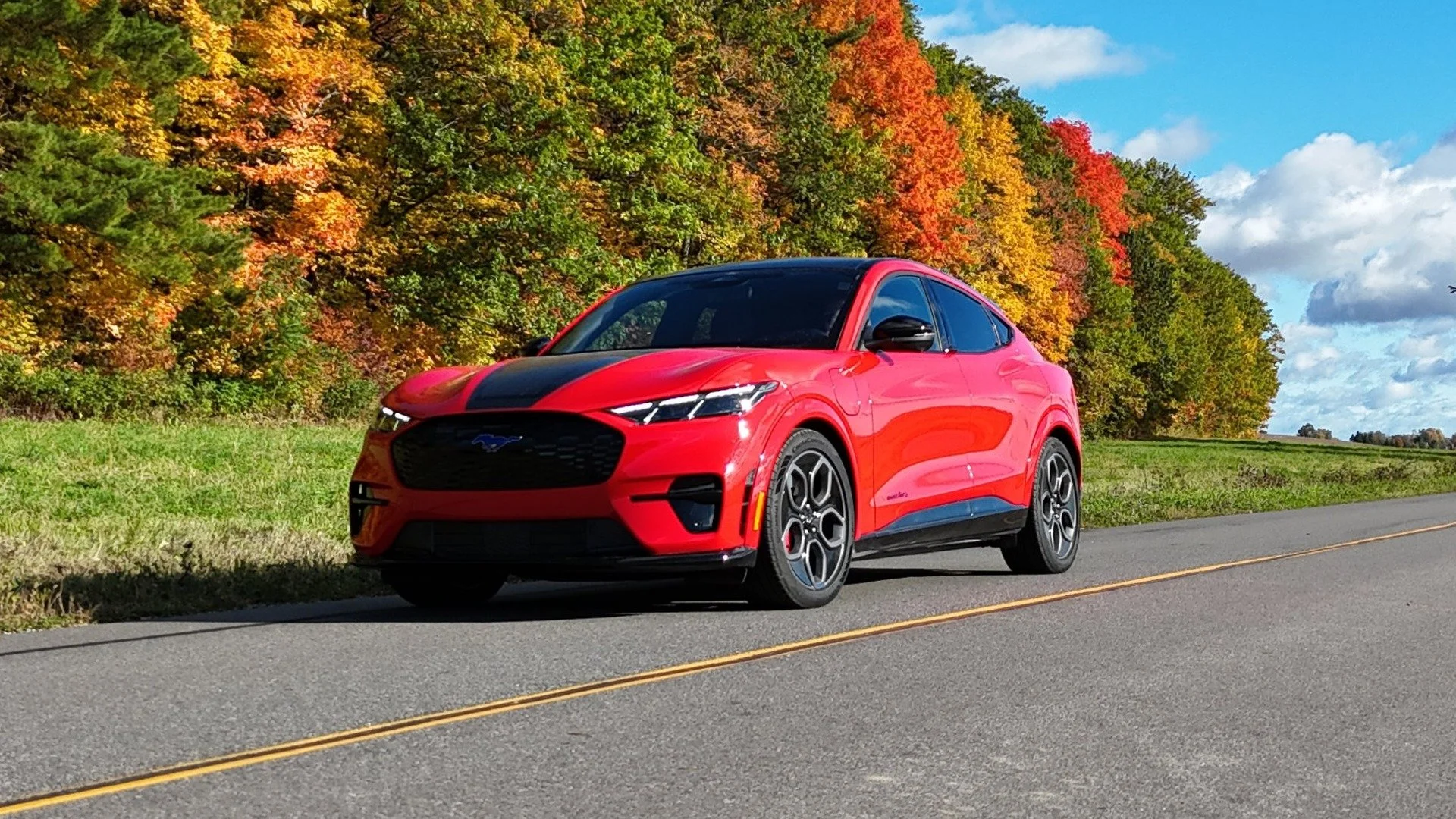
Parked side by side, the family resemblance is obvious, but the GT is the one that looks fast standing still. The California Special treatment brings the Rave Blue accents, the illuminated pony badge in the grille, the blue-over-black hood stripe, and 20-inch Carbonized Gray wheels with the GT/CS logos. Behind those wheels sit red Brembo brakes, which the Premium doesn't get.
The Premium is the cleaner, quieter-looking car, without the GT's aggression. If you want the Mustang look without shouting about it, the Premium does that well. Luc's green Premium looked sharp in the fall colours, and nobody would call it plain. It's just not trying as hard as the GT, and that's fine.
Cargo: same space, one missing piecE
Behind the rear seats, both cars give you essentially the same cargo area, around 29.7 cubic feet, expanding to roughly 59 to 60 cubic feet with the second row folded. Nothing to separate them here.
The difference is under the hood. Luc's Premium does not have a front trunk, and that's a 2026 story, not a Premium story. For 2026, Ford took the frunk off the standard equipment list across the whole Mach-E lineup and made it a $495 standalone option. Luc's car simply wasn't ordered with it. So if you're shopping a 2026 Mach-E and the frunk matters to you, check the window sticker, because the badge on the back no longer guarantees it.
Back seats: no difference worth arguing about
Legroom, headroom, getting in and out through the rear doors — if you fit in one, you fit in the other. The video covers this in detail, and the honest answer is that rear passengers won't know which car they're in. The GT's sportier mission doesn't cost the back seat anything.
Cabin and front seats: comfort versus intent
This is where the two cars' personalities split. The Premium's front seats are comfort seats: heated and ventilated, with memory for the driver, and they suit the car's everyday mission. Luc has the ventilated seats, and they work as expected.
The GT gets Ford Performance seats, more bolstering, and in the California Special they're trimmed in Navy Pier blue with reflective striping that carries through the console, steering wheel, and floor mats. They hold you in place when the car does its thing, and they look the part doing it.
Both cars share the same screens: a 15.5-inch centre touchscreen and a 10.2-inch driver display, with wireless Apple CarPlay and Android Auto. But the equipment lists diverge in the details, and the video caught them:
Wireless charging pad: standard on the GT, optional on the Premium as part of the Technology Package. Luc's Premium doesn't have it.
Power liftgate: Luc's Premium doesn't have it. For 2026, Ford moved several features that used to be standard — the frunk, the wireless charger, the power liftgate — into options or packages, so two 2026 Mach-Es with the same badge can be equipped quite differently. Check the sticker.
Ventilated seats: the Premium has them. That one is standard Premium equipment, and Luc's car proves it.
And here's the odd one, the thing that usually works the other way around. The GT California Special, the more expensive car, does not get ventilated seats. Heated seats and a heated steering wheel, yes. Ventilated, no. You have to drop down to the Premium to get them — it's the only Mach-E trim that offers them. The reason is the seat itself: the GT uses a dedicated Performance seat, more bolstering and Miko sueded inserts, and Ford only engineered the ventilation hardware into the Premium's comfort seat. The GT's money went to motors, Brembo brakes, and MagneRide suspension instead. So the cheaper car is the one that keeps your back cool in July, and the faster car is the one that doesn't. That's strange for a top trim, and it's worth knowing before you pay the step up.
Driving: this is the whole comparisoN
The Premium is quick in the way all good EVs are quick: instant, quiet, no drama. With the standard-range battery and dual motors, it makes 325 horsepower and 500 lb-ft of torque, and it gets on with the job without ever feeling stressed. Around town and on the highway, it's a genuinely nice drive, and it's the car most people actually need.
The GT is a different experience. Same dual-motor layout, but 480 horsepower and, with the Performance Upgrade, 700 lb-ft of torque. In Unbridled mode from a dead stop, it's violent in a way the Premium never hints at: 0 to 100 km/h in 3.5 seconds on Ford's claim, and it feels like it. The MagneRide suspension, which comes with the Performance and Handling package, keeps that power usable instead of just scary, and the Brembo brakes back it up.
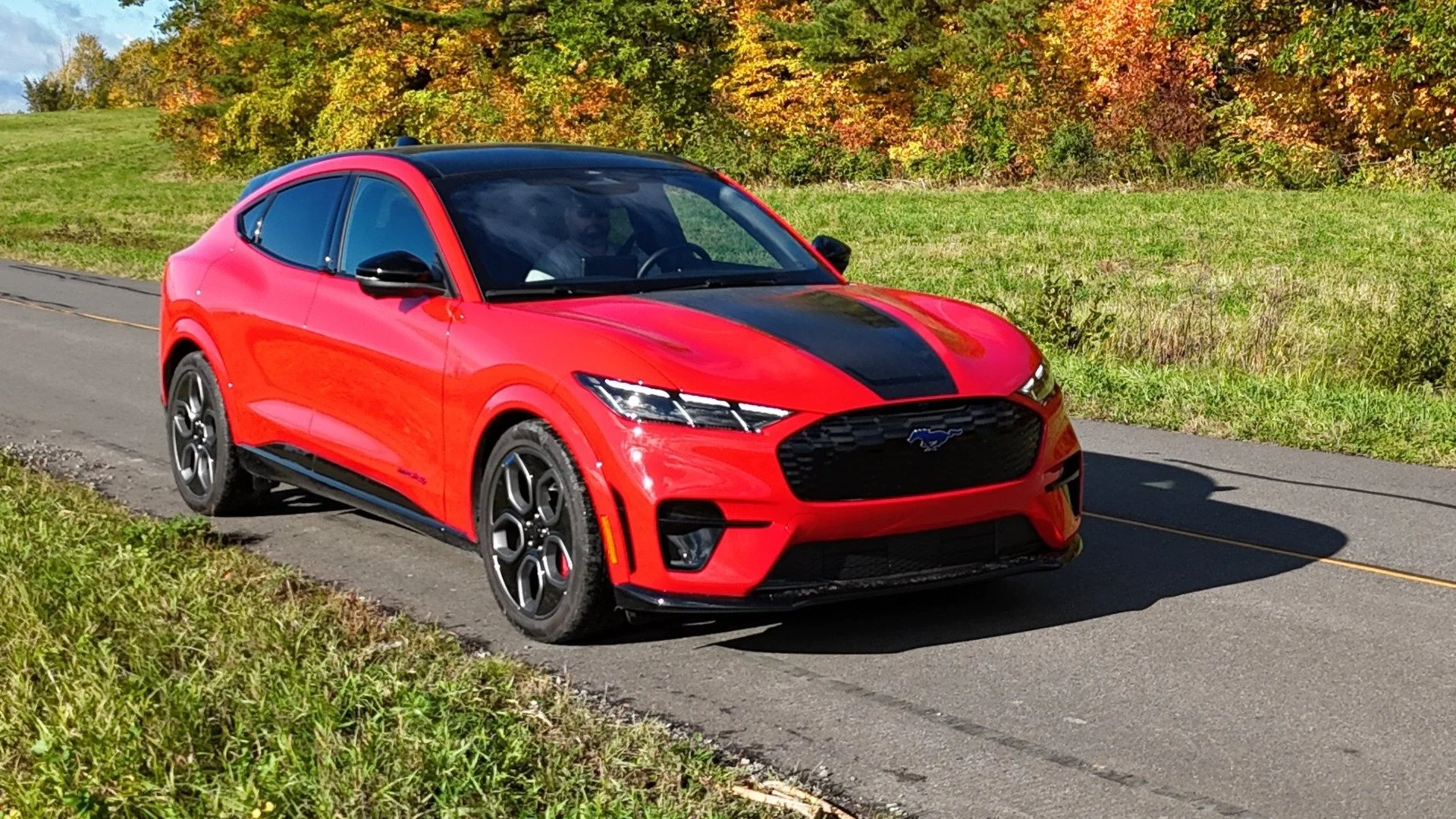
The trade is range. The GT is rated at 451 km in Canada, and in my own GT review I saw 414 km at around 5 degrees Celsius. The Premium with the standard-range battery is rated at 380 km in Canada with all-wheel drive, and the extended-range Premium stretches to 515 km. So the GT gives you the speed and takes some range back. That's the deal, and it's an honest one.
Specs
Power — Premium (Luc's, standard range, eAWD): 325 hp; GT California Special (as tested): 480 hp
Torque — Premium: 500 lb-ft; GT California Special: 600 lb-ft (700 lb-ft with Performance Upgrade)
Battery (usable) — Premium: 73 kWh, standard range (LFP); GT California Special: 91 kWh, extended range
Range (Canada) — Premium: 380 km; GT California Special: 451 km (414 km observed at ~5°C)
0–100 km/h — Premium: About 4.9 s (published figures); GT California Special: 3.5 s (Ford claim, with Performance Upgrade)
Drive — Premium: eAWD; GT California Special: eAWD
Cargo behind rear seats — Premium: ~29.7 cu ft; GT California Special: ~29.5 cu ft
Front trunk — Premium: Not equipped on Luc's car ($495 option for 2026); GT California Special: 2.6 cu ft when equipped
Peak DC charging — Premium: Not measured in this test; GT California Special: 150 kW (155 kW observed)
Ventilated front seats — Premium: Standard; GT California Special: Not available
Note: the Premium with rear-wheel drive and the standard-range battery makes 264 hp and 387 lb-ft. The extended-range Premium makes up to 370 hp and 500 lb-ft with all-wheel drive.
Pricing
Here is the part that frames the whole comparison.
Canada (MSRP, before freight, PDI, and taxes):
Premium, standard range, eAWD: from $46,995
GT: from $64,995
California Special package: just over $3,000
GT Performance and Handling package (the one that unlocks 700 lb-ft and adds MagneRide): extra, on top of the California Special package
So the step from a base Premium to a base GT is about $18,000 in Canada. The GT California Special as tested, with both packages, sits past $68,000 before taxes, and further past that with the performance package included. At the time of writing, Ford dealers were also showing a $5,000 delivery allowance on the GT and a federal EV Affordability Program amount on the Premium, which move the out-the-door numbers, but the MSRP gap is the honest comparison.
United States (MSRP, before $2,045 destination):
Premium, standard range, rear-wheel drive: from $40,595
Premium, standard range, all-wheel drive: from $43,595
GT: from $53,395
California Special package: $2,495
GT Performance and Handling package: $3,495
GT California Special as tested: $59,385 ($61,430 with destination)
The American step from a Premium all-wheel drive to the GT California Special as tested is $15,790 before destination. The jump from Premium to GT is steeper in Canada than in the US, which is worth knowing if you're cross-border shopping.
The frunk, for reference, is a $495 standalone option on any 2026 Mach-E trim in both countries.
Verdict: beast, and beast 2.0
Luc's line holds up. The Premium is the smart buy: comfortable, quick enough for anything sane, ventilated seats, and the best value in the lineup. The GT California Special is the emotional buy: 700 lb-ft, the looks, the brakes, the suspension, and a price tag that makes you think twice before you think once.
Same car. Totally different animal. Which one are you taking?
Watch the comparison:
Watch the GT review on its own:
