

General Motors is going hybrid. On October 27, 2026, the company confirmed it will invest in its Lansing Delta Township plant in Michigan to prepare for hybrid production, part of a commitment of more than $2 billion to the Lansing region over several years, including $1.25 billion previously earmarked for Lansing Grand River. A $500 million federal manufacturing conversion grant is being restructured so the money goes to hybrid production at Delta Township. Automotive News put the Delta Township portion at $750 million.
Reuters reported the hybrids will be versions of the Chevrolet Traverse, Buick Enclave, and GMC Acadia, the three-row SUVs the plant already builds. GM itself has confirmed none of that: no badges, no dates, no specs, and not even whether these will be standard hybrids, plug-in hybrids, or a mix. Chief executive Mary Barra told analysts hybrids are coming in multiple segments and will not need additional capital spending or engineering.
The context matters. GM's only hybrid on sale in the United States today is the Corvette. Hybrids took 16 percent of the American market in 2026, and GM's share slipped to 16.6 percent from 17.4 percent while Toyota's hybrid lineup kept growing. Dealers have been pressing GM for hybrids for years. So the announcement is real, but the details are a blank page.
That blank page is why it's worth looking east. Because GM already builds a modern plug-in hybrid system, and it's already on sale — just not here.
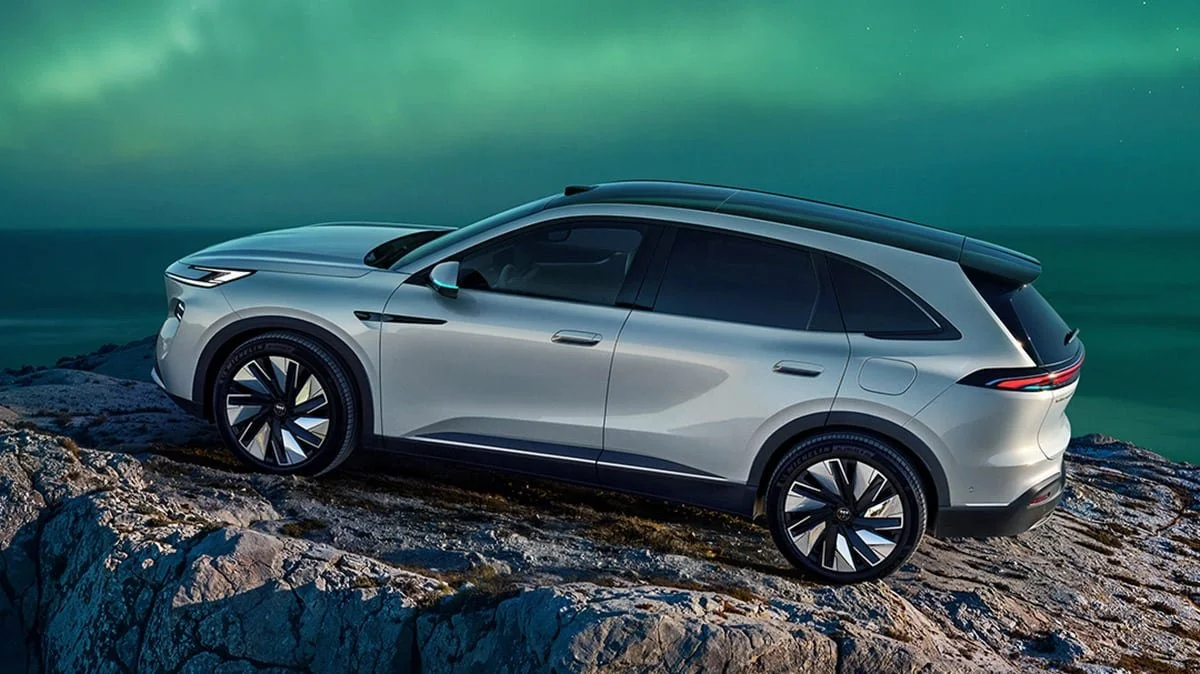
Buick Electra E7, SAIC-GM press photo.
THE PREVIEW: BUICK ELECTRA E7
The preview is the Buick Electra E7. Yes, E7. It's a mid-size, five-seat SUV built by SAIC-GM in China, launched there on April 22, 2026, from around $23,200, with more than 10,000 orders in its first 90 minutes and 5,000 deliveries within two weeks. On September 30, it became Buick's first model in South Korea, where it goes on sale in November from about $32,000, imported from China in four trims.
HOW IT WORKS
The E7 runs GM's True Dragon plug-in hybrid Pro system. It is a series-parallel setup: a single electric motor drives the front wheels most of the time. Around town it runs pure electric with the engine off. When the battery runs low, the engine switches on as a generator and the motor keeps doing the driving. At highway cruising speed or under heavy load, a clutch connects the engine to the front wheels so engine and motor drive together. Driving modes are EV, battery hold, and i-HEV.
That operating principle is the same family as the Mitsubishi Outlander PHEV and the Nissan Rogue PHEV, which is literally the Outlander system with a Nissan badge. The hardware differs: the E7 has one motor and front-wheel drive, while the Japanese pair have a motor on each axle for all-wheel drive.
Electric motor: 165 kW (221 hp), 330 Nm (243 lb-ft), front-wheel drive, single-speed hybrid transmission
Gas engines: 1.5-litre naturally aspirated, 72 kW (97 hp); or 1.5-litre turbo, 115 kW (154 hp)
Combined output: 237 kW (318 hp) with the base engine; 280 kW (375 hp) with the turbo
0–100 km/h: about 7.0 seconds
Top speed: 180 km/h (112 mph) base; 210 km/h (130 mph) turbo
Battery: 32.6 kWh lithium iron phosphate (LFP) in China; up to 31.7 kWh in Korea
Fuel tank: 65 litres
DC fast charging: 30 to 80 percent in about 15 minutes (China figure) or about 20 minutes (Korea figure)
Size: 190.9 inches long, 75.2 inches wide, 65.9 inches tall, on a 112.2-inch wheelbase
Weight: about 4,300 to 4,400 lb
Cargo: about 23.0 cu ft behind the second row, 63.5 cu ft with the seats folded
Size in context: the E7 is bigger than a Chevrolet Equinox (183.2 inches long, 107.5-inch wheelbase) and bigger than the Outlander (185.8 inches, 106.5-inch wheelbase), but clearly smaller than a Traverse (204.5 inches, 121.0-inch wheelbase). It's a tweener — and that matters for the North American question, because the sizes North Americans actually buy in volume are the Traverse and Acadia sizes, not this one. More on that below.
RANGE: THREE TEST CYCLES, PLUS OUR ESTIMATE
Electric-only range:
China (CLTC): 235 km (146 miles)
Korea (certified): 126 km (78 miles)
Europe (WLTP, for reference): 168 km (104 miles)
Estimated NRCan/EPA: 140 to 170 km (87 to 106 miles)
Combined range (full battery + full tank):
China (CLTC): up to 1,630 km (1,013 miles)
Korea: over 1,000 km (over 621 miles)
Estimated NRCan/EPA: 1,100 to 1,300 km (684 to 808 miles)
Why three different answers for the same car? The test cycles disagree by design. China's CLTC cycle is city-heavy and low-speed, which flatters plug-in hybrids — it's the most optimistic of the bunch. Europe's WLTP is stricter, Korea's domestic certification stricter still, and the EPA cycle, with its highway speeds and aggressive driving, is the strictest of all. The usual rule of thumb is that an EPA figure lands around 70 percent of a CLTC figure, and around 85 to 90 percent of a WLTP figure. Canada's NRCan ratings use test procedures aligned with the EPA, so the same estimate applies on both sides of the border.
These North American figures are Outsider Reviews estimates, not official ratings. The E7 has never been tested by the EPA or NRCan, because it isn't sold here. The estimate triangulates the three published figures: CLTC scaled by 0.71, WLTP scaled by 0.85 to 0.90, and the Korean certification as the conservative anchor. Even the most conservative anchor, Korea's 126 km, is still roughly double what the Rogue PHEV manages on the EPA test.
HEAD TO HEAD: E7 VS. OUTLANDER PHEV VS. ROGUE PHEV
Battery: E7 32.6 kWh LFP / Outlander 22.7 kWh NMC / Rogue 20 kWh NMC
Electric range, North America: E7 est. 140–170 km (87–106 mi) / Outlander 72 km (45 mi) EPA / Rogue 61 km (38 mi) EPA
Combined range: E7 est. 1,100–1,300 km (684–808 mi) / Outlander 676 km (420 mi) EPA / Rogue 676 km (420 mi) EPA
Combined output: E7 up to 375 hp / Outlander 297 hp / Rogue 248 hp
Drive: E7 front-wheel drive / Outlander and Rogue twin-motor all-wheel drive
DC fast charging: E7 yes / Outlander yes, select trims (CHAdeMO) / Rogue no
Price context: E7 from about $32,000 in Korea and $23,200 in China — but it isn't sold here, so no direct price comparison is possible. The 2026 Outlander PHEV starts at $44,990 in the US including destination; the Rogue PHEV is estimated around $44,000.
On the numbers that define a plug-in hybrid — battery size, electric range, combined range, charging — the E7's system is ahead of both Japanese SUVs, and not by a little. Its estimated electric range roughly doubles the Outlander's and nearly triples the Rogue's. Where it gives ground: it drives only the front wheels, and you can't buy one here.
THE BATTERY QUESTION — A CORRECTION
The E7's battery uses lithium iron phosphate, or LFP. The Outlander and Rogue use nickel-manganese-cobalt, or NMC. Is LFP more advanced? On energy density, no. NMC packs more energy into every kilogram, which is why it has been the default for long-range vehicles. LFP is the older, cheaper chemistry, and the industry has come back to it for three reasons: it survives far more charge cycles (roughly 2,000 to 5,000, versus 1,000 to 2,000 for NMC), it is more thermally stable, which means safer, and it costs less because it skips nickel and cobalt. It also tolerates being charged to 100 percent every day without the degradation worry that comes with NMC. So the honest version is this: LFP is a smarter choice for a plug-in hybrid that gets plugged in every night, not a more advanced chemistry. The E7's real battery advantage is the size of the pack and the fast-charging capability, not the letters on the chemistry.
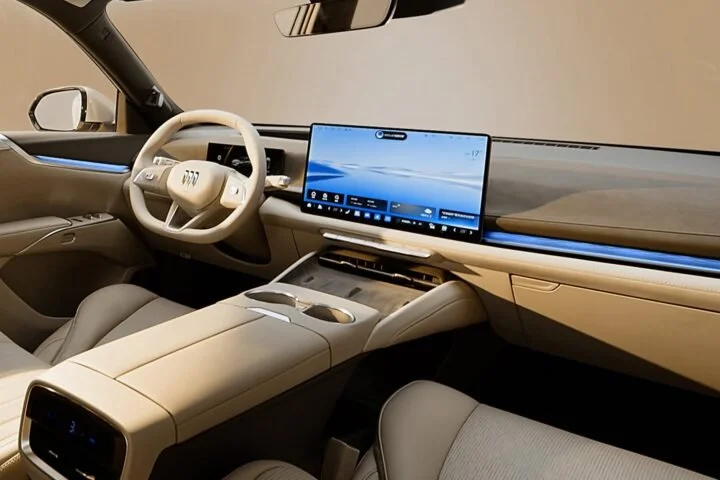
Electra E7 interior, SAIC-GM.
THE SIZE ARGUMENT
If GM brings this system to North America, it should bring it in a bigger format. The E7 is a tweener; the Traverse and Acadia are the sizes North Americans buy in volume, and they are exactly the vehicles Lansing already builds. The industry does this all the time: develop a model overseas, then scale it up for North American tastes. The E7 itself is already proof of the cross-market pattern — a China-built Buick, imported to Korea. A Traverse-sized body with this system underneath is the version that would make sense here.
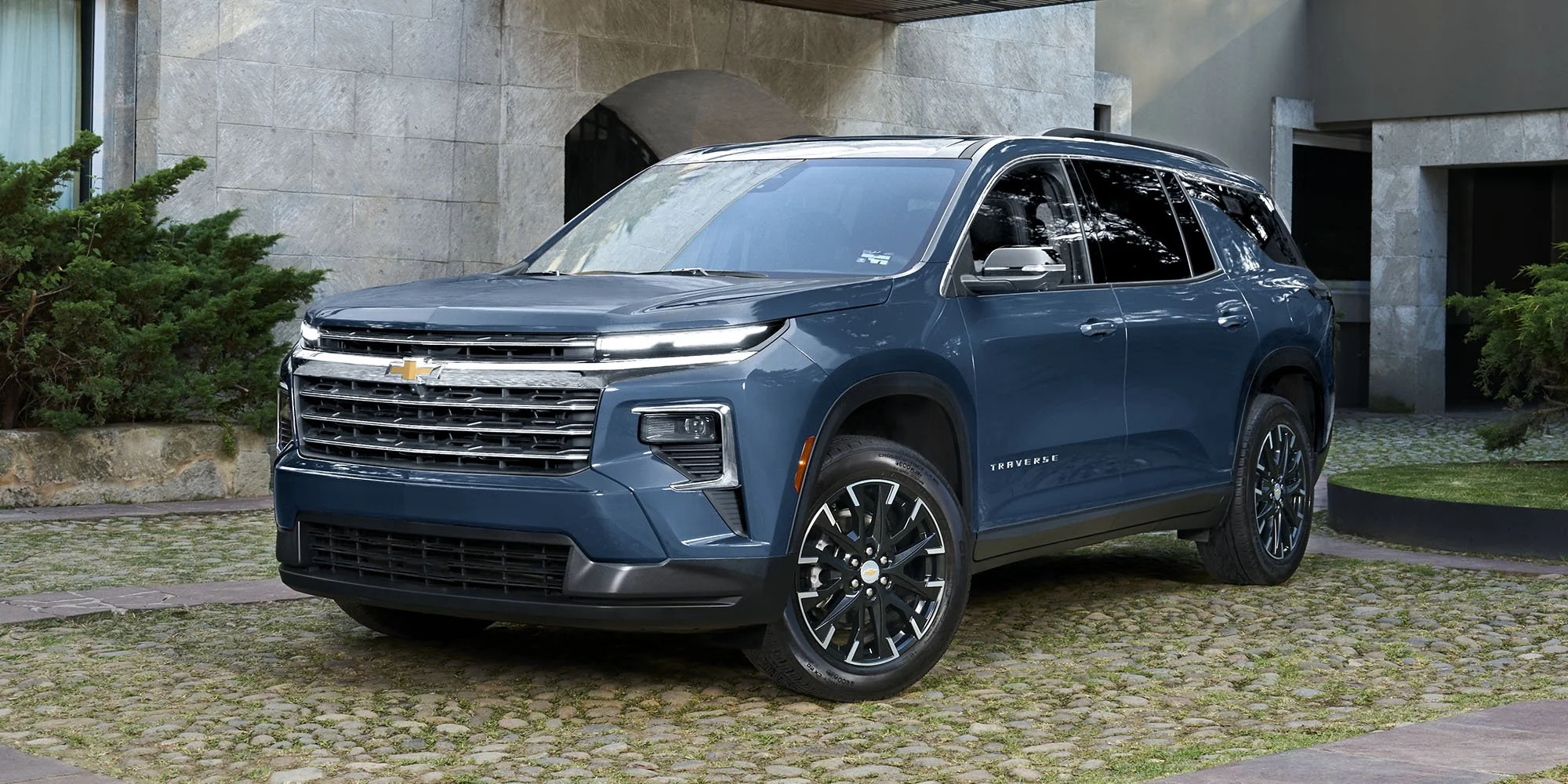
Chevrolet Traverse, the size GM’s hybrid system should land in.
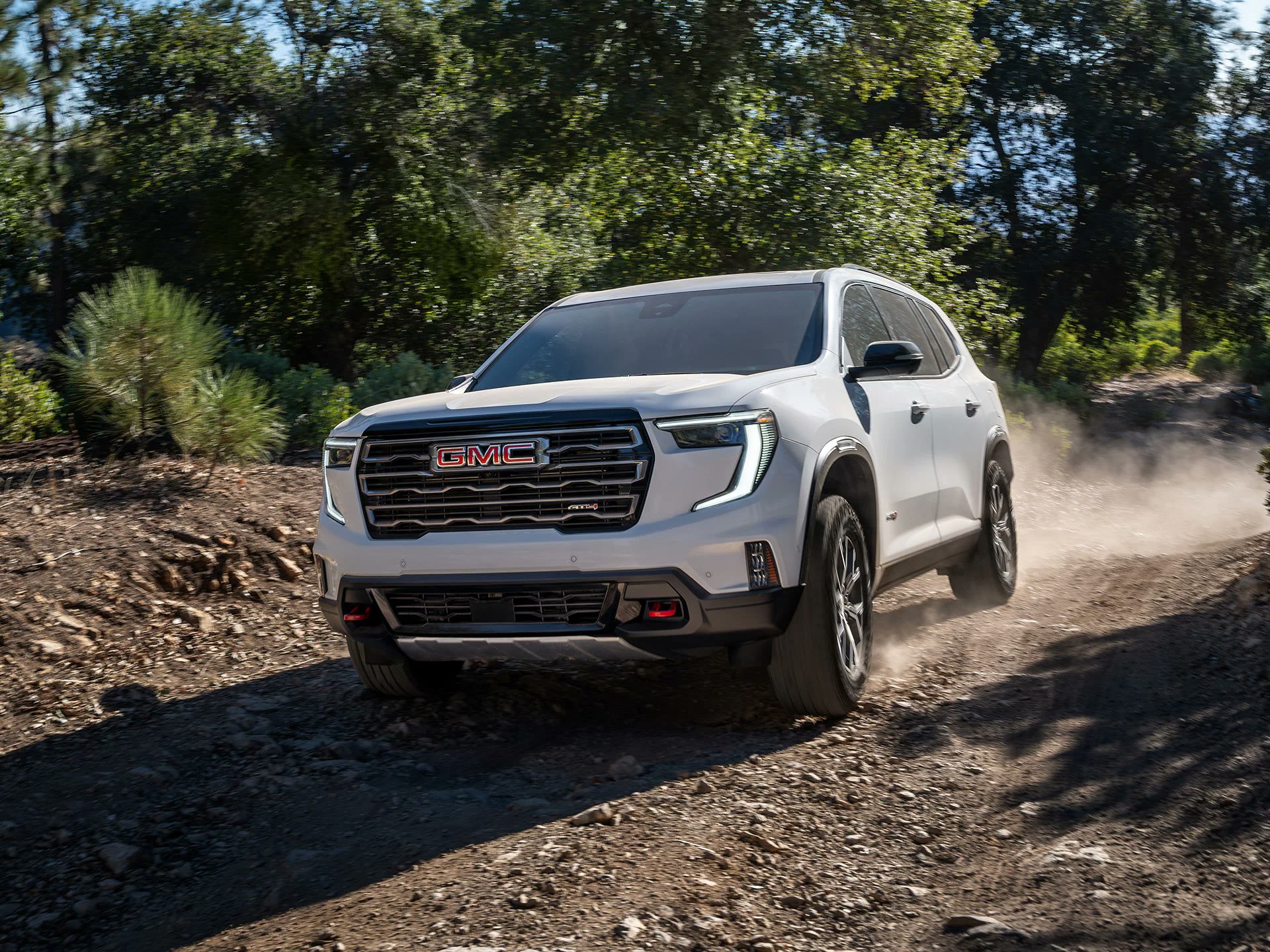
GMC Acadia.
OUTSIDER'S TAKE
General Motors is late to this party, and there is no point pretending otherwise. This is not new technology by any standard. Mitsubishi has been selling series-parallel plug-in hybrids for well over a decade, and Toyota and Ford have been selling hybrids for far longer. But there is nothing wrong with showing up late if you bring something better, and on the numbers that matter, that is apparently what GM is going to do. If the system that lands at Lansing looks anything like the E7's — a bigger battery, double or triple the electric range of the Rogue and Outlander, and real fast charging — then late could mean better. The open questions are whether Lansing gets a plug-in hybrid or a plain hybrid, when it arrives, and whether the system survives the trip across the Pacific intact. Those answers will decide whether this is a comeback or just a press release.
