

OPINION
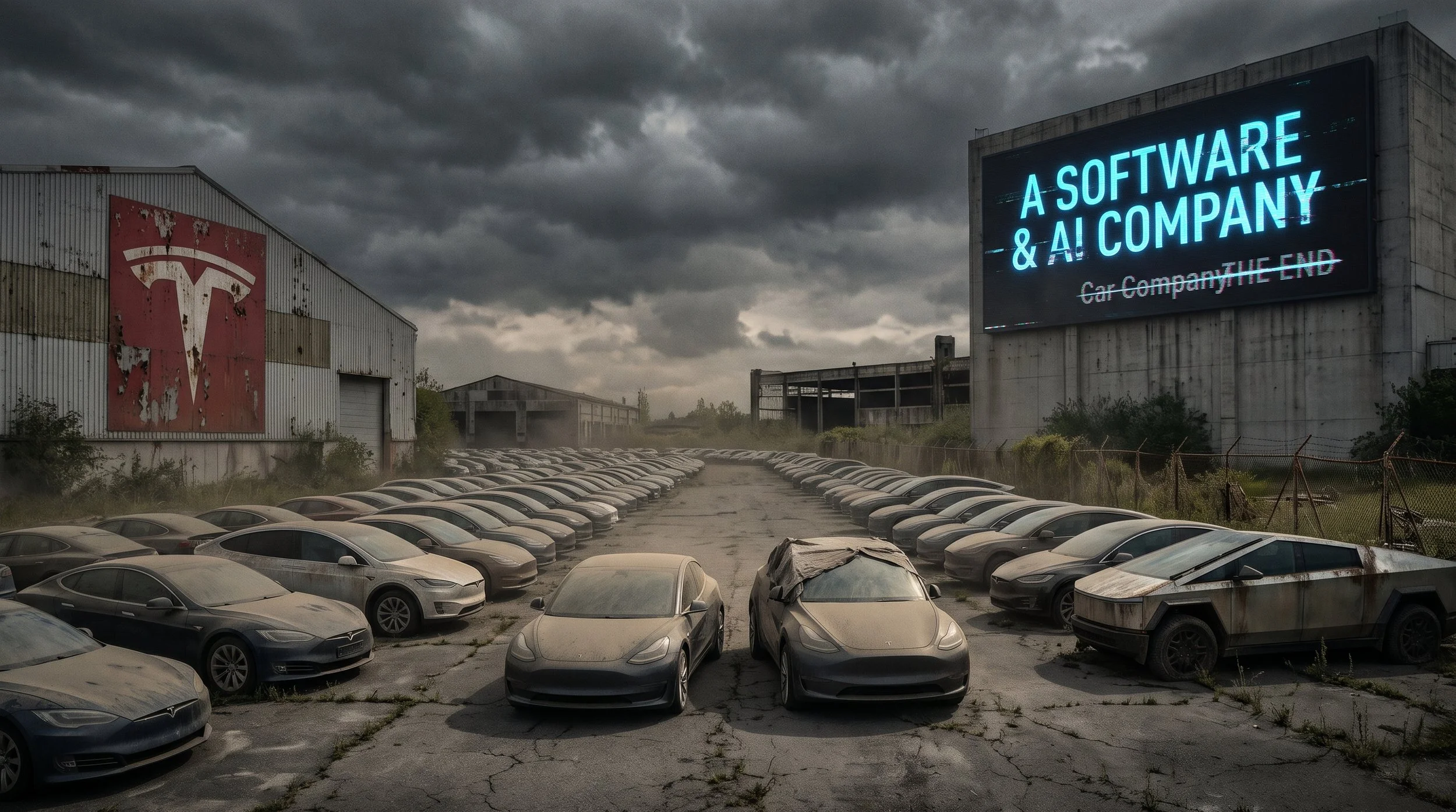
On Friday, November 6, Elon Musk announced the end of the Cybertruck in a single post on X — no press release, no warning, just one post: "Tesla will be winding down production of the Cybertruck at Gigafactory Texas around the middle of next year to make room for increased Cybercab production."
Read that again. The Cybertruck — the vehicle that was going to reinvent the pickup truck, the one with over a million reservations — is being wound down. The assembly line gets dismantled around June or July of 2027, barely three and a half years after the first trucks rolled off it. And it’s being torn out to make room for a two-seat robotaxi with no steering wheel.
This is not a product update. This is the latest chapter in the fall of a car company — and yes, I’m going to call it what it is. A car company. Because despite what its CEO keeps insisting, selling cars is the only thing that has ever made Tesla real money, and Tesla is quietly stopping making most of them.
A Car Company With Two Cars
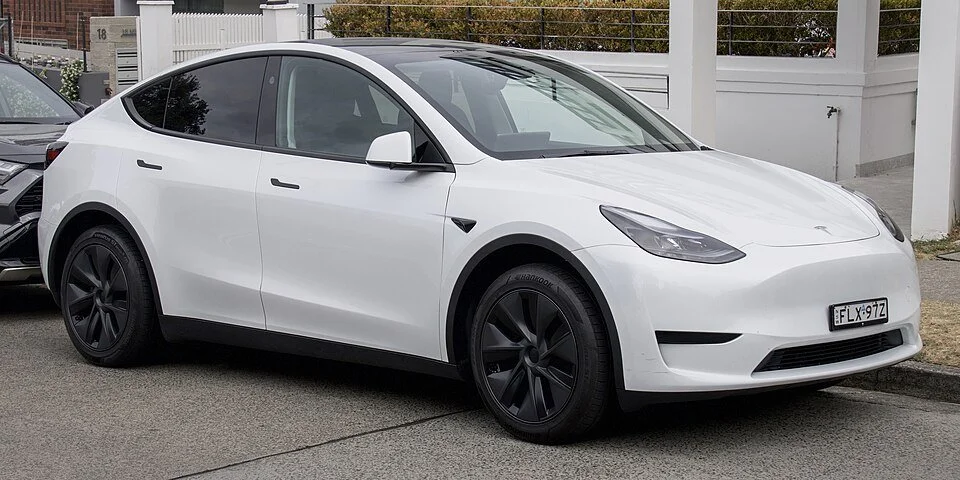
The Tesla Model Y: soon, one of only two cars Tesla still sells. Photo: Wikimedia Commons.
Let’s count what’s left.
The Model S and Model X are gone. Not “being phased out” — gone. Musk announced it on Tesla’s earnings call back in January 2026, saying it was time to bring both programs to an end “with an honorable discharge.” The final cars were built in the second quarter of 2026, the Fremont production lines have been decommissioned, and Tesla’s own website now states flatly that the Model S and Model X are “no longer in production.”
The Cybertruck follows in mid-2027. After that, the entire consumer lineup of the most valuable car company on Earth is two vehicles: the Model 3 and the Model Y. Two cars. The Cybercab is a fleet-only robotaxi you can’t buy. The Semi is a commercial transport truck. The Roadster, promised since 2017, is still listed by Tesla itself as “design development.”
Five years ago Tesla was going to dominate every segment on the road. Today it’s a two-car company with a robotaxi experiment. That’s not a lineup. That’s a retreat.
The Cybertruck Autopsy
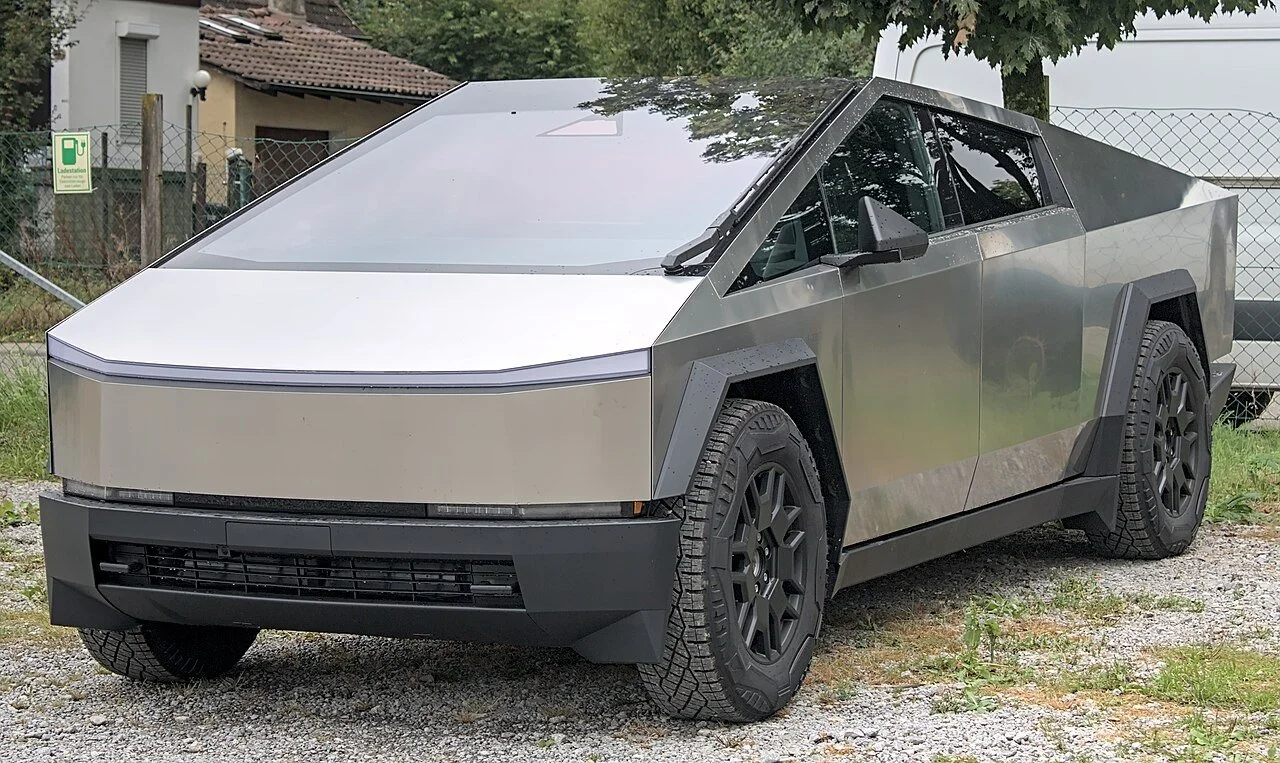
The Cybertruck: promised to dominate the truck world; wound down by mid-2027. Photo: Wikimedia Commons.
No vehicle tells the story better than the Cybertruck itself, so let’s do the autopsy properly.
Unveiled in November 2019, it was promised to start at $39,900 US, with a top tri-motor version offering over 805 km (500 miles) of range and 14,000 lb of towing for $69,900. Musk later said there were more than a million reservations, and predicted Tesla would be building roughly 250,000 Cybertrucks a year by 2025.
Here’s what actually happened. US sales, per Cox Automotive estimates: 38,965 trucks in 2024. Then 20,237 in 2025 — down 48 percent. Through the first nine months of 2026: 11,586, down another 28 percent.
And even those numbers flatter the truck, because when the public stopped buying, Musk started selling them to himself. In the fourth quarter of 2025, SpaceX — his rocket company — bought 1,279 Cybertrucks. According to S&P Global Mobility registration data, that was 18 percent of every Cybertruck registered in the United States that quarter. SpaceX’s own financial filings put the tab at $131 million US, paid at full sticker price. His other companies kept buying into January and February 2026. Against the Cybertruck’s entire 2025 sales, the SpaceX money alone works out to roughly 6 to 9 percent of every truck “sold” that year. The stated reason was replacing SpaceX’s gas-powered support trucks at Starbase. Maybe so. But a truck the public actually wanted wouldn’t need its maker’s brother company to clear the lot.
The $16,000 range extender that was supposed to fix the range shortfall was cancelled in 2025, deposits refunded. And the same week Musk announced the wind-down, Tesla raised prices again — the cheapest Cybertruck you can actually order now starts at $92,490 US.
The delivered truck maxes out at 523 km (325 miles) of range and 11,000 lb of towing — and the base version tows just 7,500 lb. I’ll say what I’ve said since I first saw it in person: it’s the worst electric truck a person can buy. Set the dumpster styling aside, because you don’t need it for the verdict. The interior is a tablet glued to a slab — minimalism used as an excuse to build cheap — and you’re asked to pay a premium price for it.
Meanwhile, the actual kings of the electric truck world come from General Motors. The Chevrolet Silverado EV goes up to 793 km (493 miles) of EPA-estimated range and tows 12,500 lb. The GMC Sierra EV does 769 km (478 miles), also 12,500 lb. I know, because I own one: my Silverado EV Work Truck is rated at 682 km (424 miles), and I’ve towed a 6,500 lb camper through some of the steepest grades in Quebec with it, in the fast lane, with no compromises. That’s what a real electric truck looks like.
And in Canada, it isn’t close on price either. The cheapest Cybertruck Tesla will sell you here is the Premium AWD at $139,990 — the cheaper base model isn’t even offered in Canada. My Silverado EV Work Truck, with the Extended Range battery, listed at $81,000, and a $5,000 federal business incentive brought its price to $76,000. Nearly double the money for the Cybertruck, in exchange for less range and less truck. Tesla promised to dominate this segment. Instead, it’s leaving it.
Where It Started: Twitter
Elon Musk. Photo: Wikimedia Commons.
Every fall has a starting point, and for Tesla it isn’t a car. It’s a social media company.
In 2022, Musk bought Twitter for about $44 billion US. To do it, he sold roughly $23 billion worth of Tesla stock across that year. That’s the moment the mission changed. Tesla stopped being the mission and became the bank — the cash cow milked to finance whatever had captured its CEO’s attention that season. First it was “free speech.” Then it was politics, and using his platform to try to influence how people vote. Now it’s robots and robotaxis. The obsession changes. The pattern doesn’t: the car company pays, and the car company waits.
You can watch the consequences in the delivery numbers. Tesla peaked in 2023 at 1,808,581 vehicles. In 2024 deliveries fell for the first time in its history. In 2025 they fell again, harder — down 8.6 percent to 1,636,129. In 2025, Tesla’s registrations in Europe dropped 27 percent while the European EV market grew by roughly 30 percent. Read that twice: the market grew, and Tesla shrank. In China, Tesla’s home-field battleground, retail sales fell in 2025 for the first time ever, and fell again through 2026 to their lowest level in at least four years.
“Not a Car Company” — The Pivot vs. the Ledger
Musk’s answer to all of this is that Tesla was never really a car company. He’s said it plainly: “We really should be thought of as an AI robotics company. If you value Tesla as just an auto company, fundamentally, it’s the wrong framework.” He’s said roughly 80 percent of Tesla’s value will be his Optimus humanoid robot. As recently as October 2026: “Optimus and Cybercab will be the vast majority of Tesla’s value.” Tesla’s own filings now describe “our transition from a hardware-centric business to a physical AI company.”
Fine. Let’s check the ledger. In 2025, Tesla took in $94.8 billion US in total revenue. Automotive — cars — was $69.5 billion of it, about 73 cents of every dollar. The robots have contributed no disclosed revenue at all. And even the easy money is drying up: regulatory credits, the cheques other automakers write Tesla for the right to keep polluting, brought in $2.76 billion in 2024. By the third quarter of 2026 they’d collapsed to $113 million in the quarter, down 73 percent year over year.
And what did the pivot cost the car business? The Fremont floor space where the Model S and X were built is being converted into a robot line “designed for” a million Optimus units a year. Designed for. As of Tesla’s latest reports, Optimus output is described as its “first production-quality bots,” with no unit count and no paying customer disclosed. A real car line, deleted, for a press release with legs.
The Robotaxi Reality Check
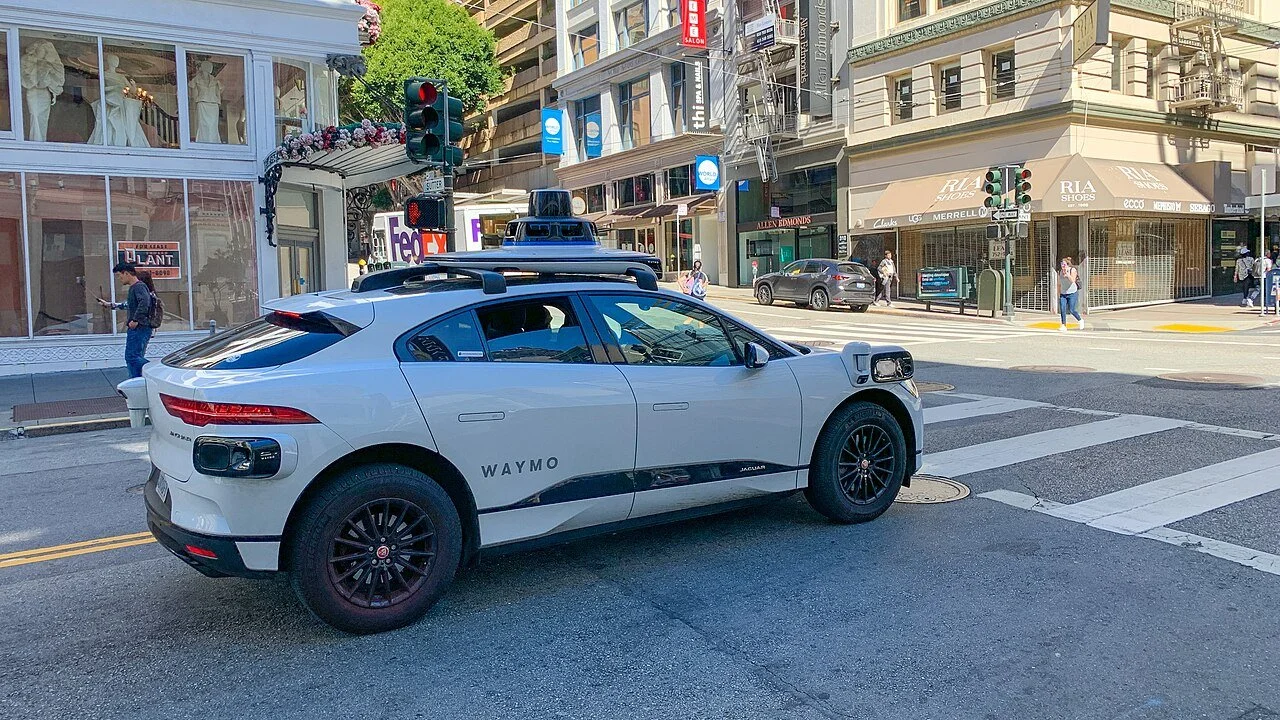
A Waymo driverless taxi: more than 500,000 paid rides a week, no safety driver. Photo: Wikimedia Commons.
The Cybercab is the other half of the bet — the vehicle the Cybertruck line is being dismantled for. So how is the robotaxi war actually going?
Waymo, Alphabet’s operation, was already reporting more than 500,000 fully driverless paid rides per week back in the spring of 2026, across what is now 15 US metro areas, with a fleet of more than 4,000 vehicles and over 300 million fully autonomous miles driven. No safety driver. Published numbers.
Tesla’s service, by comparison, launched in Austin in June 2025 with a safety monitor riding in the vehicle. It has since expanded — unsupervised service in a handful of Texas and Florida cities — but Tesla has never published how many rides it actually gives. Its Cybercab rides are Austin-only, and here’s the part that tells you everything about trusting this company: the Cybercab has no steering wheel, no pedals and no mirrors, Tesla certified it as compliant with federal safety standards itself, and in September 2026 the US safety regulator, NHTSA, opened a formal audit into how that certification was done. That audit is still open.
Tesla is not leading the robotaxi race. It’s not close to leading it. It’s dismantling a truck line to chase a competitor that is years ahead of it — with a car the federal government is actively asking questions about.
Meanwhile, the World Moved On
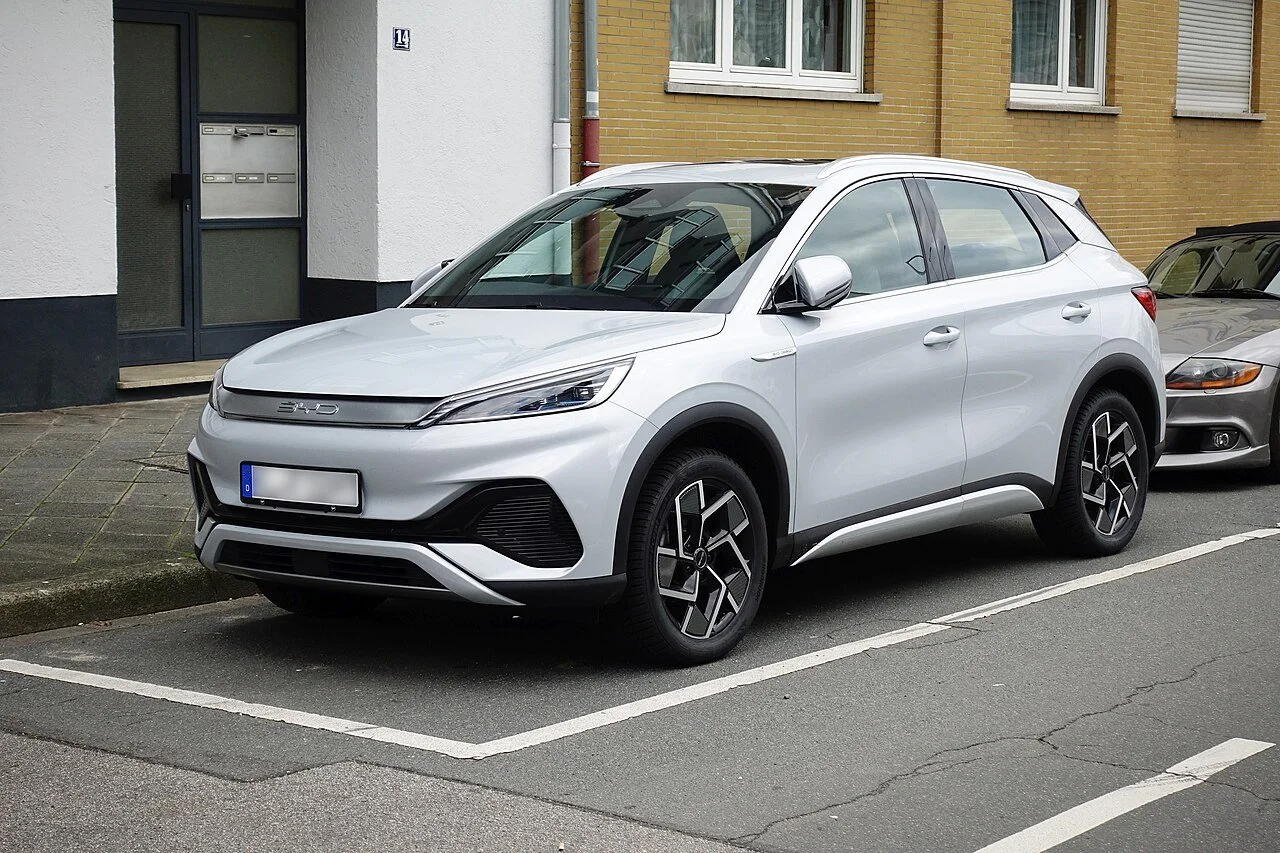
A BYD Atto 3. BYD outsold Tesla by more than 620,000 battery-electric cars in 2025. Photo: Wikimedia Commons.
And while Tesla chased robots, the car business it abandoned went to someone else.
In 2025, China’s BYD sold 2,256,714 battery-electric cars. Tesla delivered 1,636,129. BYD didn’t edge Tesla out — it beat it by more than 620,000 vehicles, and through the first nine months of 2026 it was still ahead by roughly 305,000. The world’s biggest EV maker is no longer Tesla. It hasn’t been for a while. It just took the headlines a year to catch up.
This is what decline actually looks like. Not a bankruptcy, not a fire — a slow handover. Segment by segment, market by market, Tesla’s lead has been given away: the truck segment to GM, the sales crown to BYD, the robotaxi race to Waymo, and the lineup to a CEO who’d rather be doing almost anything else.
The Receipts: A Decade of Broken Promises
People ask why I never trusted this company. It’s not a feeling. It’s a paper trail, and it’s a long one.
Full Self-Driving. In October 2016, Tesla announced that every car it built from then on “will have the hardware needed for full self-driving capability” — Level 5 autonomy hardware, Musk said, in every car. Owners paid as much as $15,000 US for the Full Self-Driving package on the strength of that promise. In January 2025, on an earnings call, Musk finally said the quiet part out loud: “We’re going to have to upgrade people’s Hardware 3 computer, and that is the honest answer. And that’s going to be painful and difficult, but we’ll get it done.” By April 2026 he went further: “Hardware 3 simply does not have the capability to achieve unsupervised FSD.” Millions of cars carry that hardware, and by industry estimates more than half a million owners paid for the FSD package itself. As of today, not one customer-owned Tesla can drive itself unsupervised anywhere — and the hardware upgrade Musk promised in 2025 still has no program, no price and no date. His other comment on that 2025 call: “I’m kind of glad that not that many people bought the FSD package.” So are his shareholders, I imagine. His customers, less so.
The deadlines. Musk promised a fully autonomous coast-to-coast drive — Los Angeles to New York, no touch, including the charging stops — by the end of 2017. It never happened; he re-promised it through 2018 and then quietly stopped mentioning it. In April 2019 he predicted “over a million robotaxis on the road… next year for sure.” By the end of 2020 there were zero. FSD was still a hands-on driver assist, and Tesla’s own lawyer had written to California regulators confirming the system “will continue to be an SAE Level 2” feature. Level 2 means the driver drives. That is the opposite of a robotaxi.
The range game. Tesla played the EPA test cycle harder than anyone: where most automakers took the standard 30 percent adjustment factor, Tesla ran extra test cycles to earn factors as low as 24.4 percent — the difference between claiming 507 km (315 miles) for a Model Y Performance and the 470 km (292 miles) the standard method would have produced. It was legal. It was also the rosiest number the rules allowed, and real drivers couldn’t reach it. Edmunds’ 2021 real-world test found every Tesla it tested fell short of its rating while most rivals beat theirs — a Porsche Taycan went 59 percent past its number. An SAE study found three Tesla models averaging 26 percent below advertised range. The EPA’s own audits forced Tesla to cut the range figures on all six models it tested, by an average of 3 percent. When the EPA tightened the test rules, Tesla slashed advertised ranges across the lineup in January 2024 — the Model Y Long Range dropped from 531 km (330 miles) to 499 km (310 miles) overnight, with no change to the car underneath. South Korea fined Tesla $2.2 million US for exaggerating range and hiding cold-weather losses of up to 50.5 percent. The US Department of Justice subpoenaed Tesla over its range claims in 2023; no charges were ever announced.
And when owners complained their cars couldn’t hit the numbers? Reuters reported in July 2023 that Tesla had quietly built a “Diversion Team” in Nevada whose job was to cancel range-related service appointments — fielding up to 2,000 cases a week, with a target of closing about 750 of them — and that the cars’ dashboards were programmed to show “rosy” range projections while the battery was above 50 percent, according to people familiar with the software, on a directive Reuters attributed to Musk himself: “Elon wanted to show good range numbers when fully charged.” Tesla did not respond to Reuters’ questions. Meanwhile, I have beaten my Silverado EV’s rated range more than once. That’s what an honest number looks like: one a customer can actually reach.
Battery swap. In 2013 Tesla demoed a 90-second battery swap, live on stage, faster than filling a gas tank. “Do you prefer faster, or free?” Musk asked. Swap stations were promised along major corridors. What actually got built was exactly one station, at Harris Ranch, California, in a former car wash, open by appointment to invited owners. Musk admitted in 2015 that of some 200 invited owners, four or five tried it, once each: “People don’t care about pack swap.” The station was gone by 2016. What the swap capability did accomplish: California’s rules awarded up to seven emissions credits per car for the fast-refuelling capability that swapping provided on paper — credits Tesla could sell, attached to a feature essentially nobody ever used — until California rewrote the rules in 2015 to require actual refuelling events.
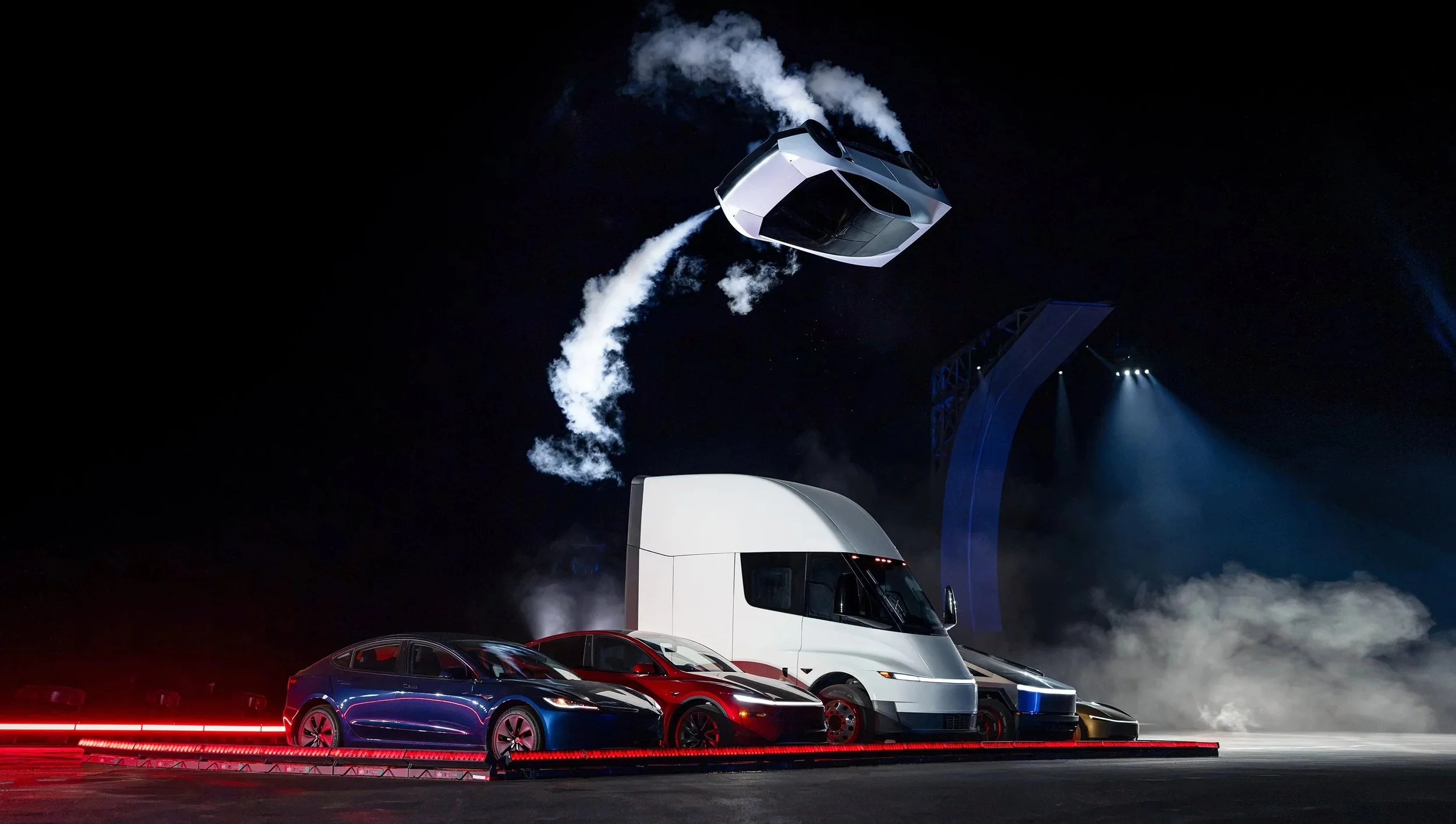
Tesla’s redesigned Roadster performs its airborne flip over the lineup at the October 2026 demo in Texas. Nine years after the reveal, there is still no production car. Photo: Tesla demo via Teslarati.
The Roadster. Revealed in 2017: $200,000 US, 998 km (620 miles) of range, production in 2020. Tesla collected $50,000 reservations, and $250,000 paid in full from the first 1,000 Founders buyers. The car then slipped year after year — 2021, 2022, 2023, 2025 — while Musk promised a SpaceX rocket package that would let it fly. In October 2026, Tesla finally demoed a redesigned car performing a brief airborne flip on cold-gas thrusters, driverless, for a few seconds. Spectacular. Also: range is now quoted at just over 483 km (300 miles) — less than half the 2017 promise — there is still no production car and no customer delivery, production is now claimed for 2028, and the full-flight version is “not approved for public road use.” Sam Altman, who reserved in 2018, posted that after seven and a half years of waiting, his refund-request email bounced. (He was refunded within 24 hours — after the post.) Nine years on, the Roadster is still a demo.
The rest of the catalogue. A “compelling $25,000 electric vehicle,” promised in 2020 for about 2023 — until October 2024, when Musk called a regular $25K model “pointless… silly” and declared the steering-wheel-less Cybercab to be the real $25K car. The Tesla Semi: “production begins in 2019.” First customer deliveries came in December 2022, and high-volume production only in 2026. The Solar Roof: 1,000 roofs a week targeted by the end of 2019. Independent estimates put total installs at roughly 3,000 by early 2023 — about 21 a week — and in 2026 installers reported Tesla had stopped offering the tiles.
Funding secured. In August 2018 Musk tweeted that he was considering taking Tesla private at $420 a share: “Funding secured.” The SEC charged him with securities fraud, saying the funding had never been confirmed. Musk and Tesla settled without admitting or denying the charges: $40 million US in penalties, and Musk out as chairman for three years. A year later he was telling buyers that a Tesla was “an appreciating asset — not a depreciating asset” that should be worth “$100k to $200k” once the robotaxis arrived. The robotaxis didn’t arrive. The depreciation did.
That’s not a company that occasionally misses a deadline. That’s a pattern with a business model underneath it: announce the future, collect the money, move on to the next announcement. Remember it the next time a delivery date, a range figure or a production ramp comes out of Austin.
The Outsider’s Take
I’ve never trusted Tesla, and the receipts above are exactly why: trust is built on doing what you said you’d do. A $39,900 truck that starts at $92,490. Five hundred miles of range that became 325. A million reservations that became 20,000 sales a year. Every big promise from this company comes with an asterisk that only shows up after the deposit clears.
And I’ve never trusted the man running it. A social network. A rocket company, a tunnel company, an AI company, a brain-chip company, a political influence operation, and a robot army to build. Somewhere near the bottom of that list sits a car company — the only one of his ventures that actually pays its own way — getting whatever attention is left over.
The rise of Tesla was real. It dragged an entire industry into the electric age and built the charging standard the rest of us now use. That Tesla deserved the admiration it got. But that Tesla is gone, and what replaced it is a two-car company winding down its halo truck to build robotaxis it’s years behind on, while its CEO insists the cars were never the point.
The cars were the point. They were the whole point. The beginning of the end started the day he decided they weren’t.
— Patrick Cayer, Outsider Reviews
Patrick Cayer is a retired Canadian Armed Forces member (19 years of service) and the founder of Outsider Reviews, where he reviews vehicles with no jargon and no favours owed. The Silverado EV mentioned above is owned by his company and used for his towing tests.
